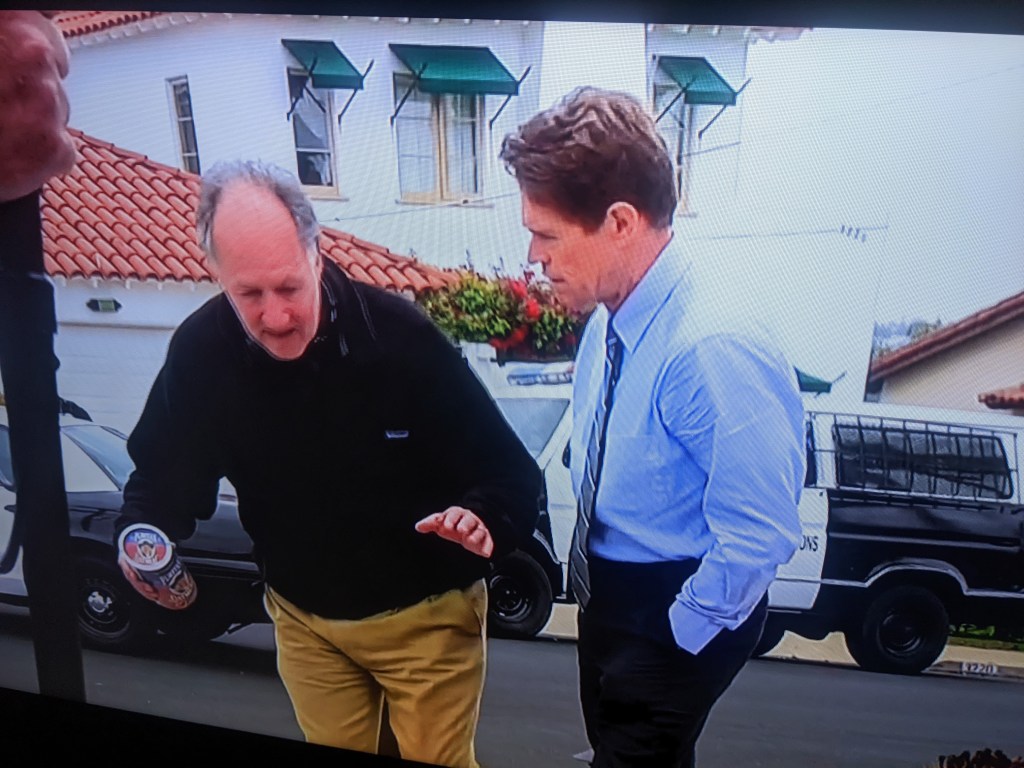
“We caught ourselves at the crossroads of a story, where myth and reality become one…”
So begins Ballad of a Righteous Merchant (2017), Herbert Golder’s documentary about Werner Herzog. Ballad was shot during the filming of Golder and Herzog’s co-written film My Son, My Son, What Have Ye Done. I had never heard of My Son prior to stumbling across Ballad for free on the streaming site Tubi. Ballad is as essential Herzog viewing as Burden of Dreams, Les Blank’s 1982 nail-biting doc about the nearly disastrous making of Fitzcarraldo.
Following the hushed excitement of Golder’s introduction, the narration continues over behind-the-scenes footage of My Son in sweeping, symphonic words uttered in loving fascination of Herzog as main character. On screen, the cacophony of a film set is punctuated by slight absurdity – a pink house swarmed by a SWAT team, a plastic figurine of a flamingo smashed into a tree, a jiggling bowl of shiny jello. Amidst the chaos, one’s eye is trained to the solid and magnetic figure of Herzog. Unlike the Herzog of interview documentaries, where he sits as anchor holding space for his subjects, Ballad shows a dynamic artist in his element, taking space behind so that the art of the story may flow in front of the camera.
Instead of coming off as overly pompous, the verbosity of the narration comes off as deep and resounding respect. The grandiloquence matches the scale of Herzog’s films. By just letting the camera roll, Ballad attempts to capture that Herzogian quality in Herzog. Herzog’s films suggest that if the camera could just roll long enough in the exact right way, the elusive soul of a hero might be captured on film. As a viewer, we know the heroes, the central figures of Herzog’s documentaries, are real and authentic. The process of unveiling of their nearly primitive inner drives, of their souls to defy odds to discover a secret treasure of existence, makes the Herzogian hero feel fictional. As viewer, we simultaneously feel as if we are seeing reality behind the myth but also breaking through reality to behold the truth of the myth.
Herzog’s devotion to the ineffable soul is as much his medium as the camera. Paintbrush gestures on canvas are akin to Herzog’s setup of each scene. For moments, Herzog allows everyone else on set to prepare, while he takes small moments waiting in the wings, smoking a cigarette, in one scene assuringly touching the arm of his wife who shows on set. Then, as soon as the camera rolls, Herzog is in full immersion in the world in front of the camera. One can imagine that Herzog is as devoted to any of the most striking large format shots of films past, as he is to the choreography between Willem Dafoe and a can of Quaker Oats.
Golder, who co-wrote My Son, My Son, is a classical scholar with a specialty in Greek mythology. He nearly beholds Herzog as Greek hero in this film. His voice drips with reverence as he describes some eccentricities and particularities of Herzog. This is what makes Ballad fun to watch. I won’t spoil the secrets – the delight of watching anything Herzog is the sum of the revelations accumulated throughout the film.
Update 12/24/22: I watched My Son, My Son, it’s free on Youtube. The only description I’ll use is it’s “Lynchian Herzog” all the way.
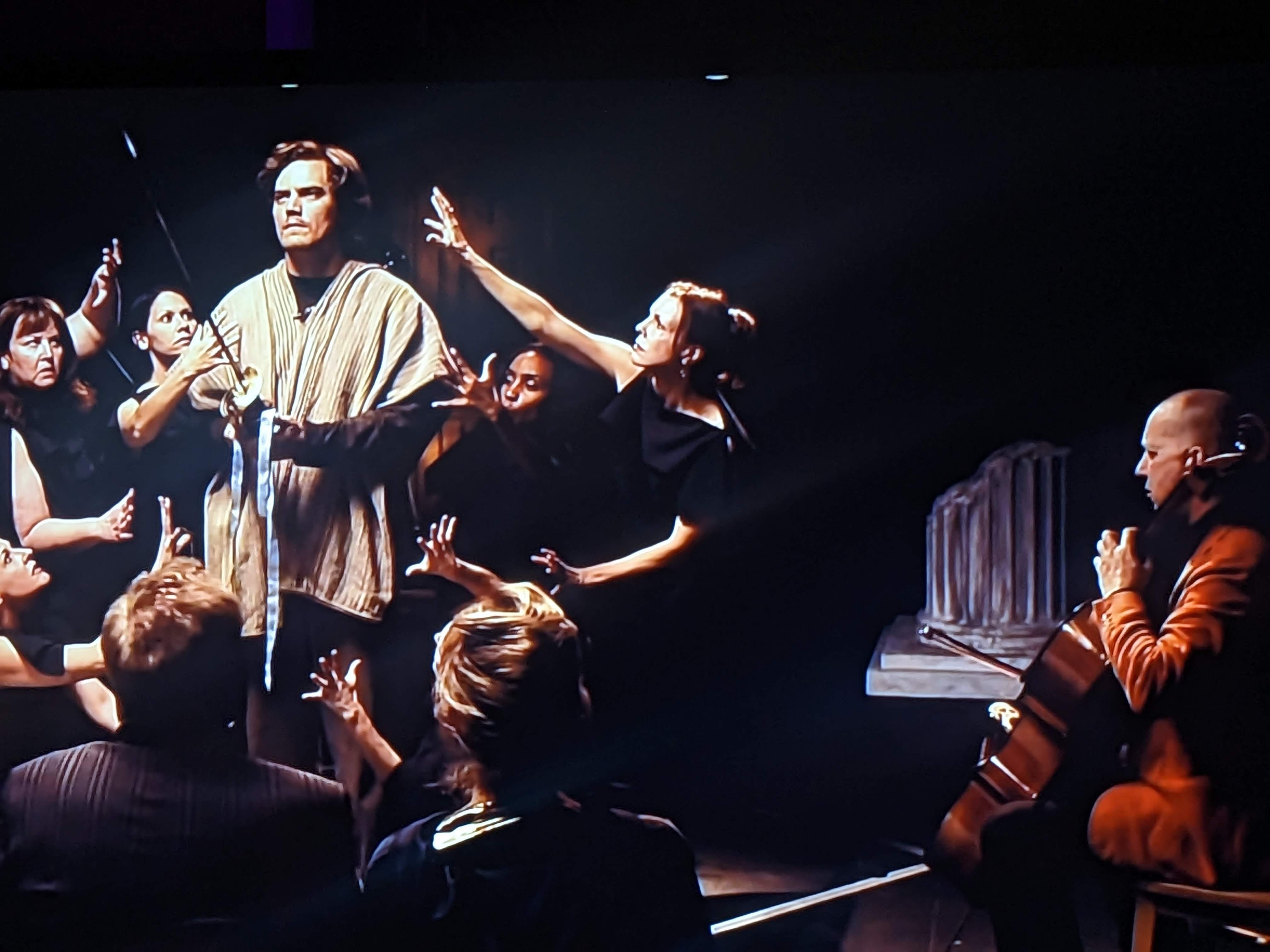
 Herzogian