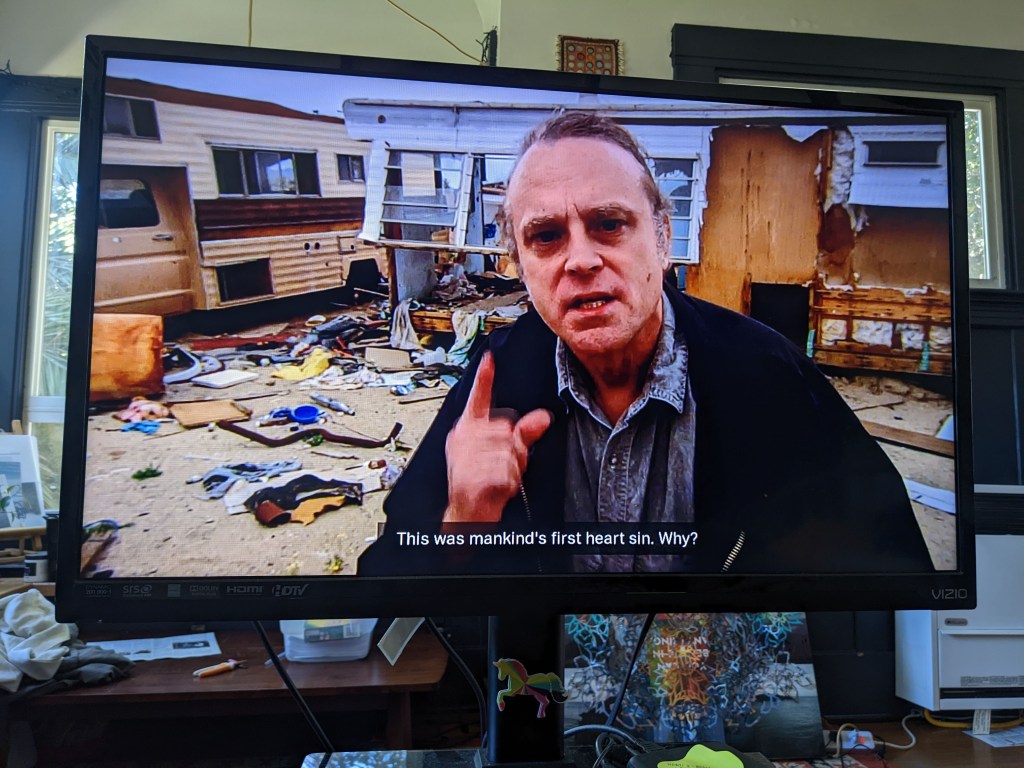
A Brad Dourif Appreciation Post.
I think people could use the words underrated and underappreciated to describe Brad Dourif, but I think I’d like to get that out of the way and just say that he’s a fuckin’ genius.
Who else can boast such accolades as:
- Been in one of the planet’s most successful franchises, as a skin-crawling, unforgettable creep
- One of the top two characters, on one of the top HBO series of all time
- Scene stealer in IMO, the most underrated film of the Aliens franchise
- Was the voice of MUTHAFUCKIN’ CHUCKY!!!
Yet I’m guessing he can probably go get groceries or have a meal out with his family and not get hounded for autographs.
Dourif’s piercing blue, unblinking eyes laser into your soul as he monologues in character as The Alien: “My Planet is: The Wild. Blue. Yonder!”
This film is a bit Dada, chaotic, a bit mournful, and a bit “out there.” Herzog decontextualizes footage from a space shuttle mission and an Antarctic dive, interspersing with Dourif walking through Slab City, CA. It feels like a leveling up in conceptual experimentation and communicating the philosophy of Herzog, similar to Lessons of Darkness and Fata Morgana.
The Alien’s soliloquy continues, relating the voyage of a spaceship passing the Earth en route to Alpha Centauri. The spaceship makes observations of mankind and history with comments on the madness, murder, and rebellion on Earth. For me, it would hardly be possible for anyone else to recite Herzog’s philosophy. There’s a force and a delicacy in Dourif’s performance that delivers an indictment against mankind’s sins with derision and compassion.
He names the domestication of pigs for food is mankind’s first sin. This is the beginning of mankind becoming sedentary. The domestication of animals for food, as distinct from the domestication of animals like dogs, as “they’ll go with you on your nomadic hunts.”
A decision to settle from the spaceship is made, as a reasonable solution for protection from chaos. “Chaos is not a negative thing – it allows us to conserve energy in many ways,” says a scientist. Chaos is what allows space travel to happen, as chaos is harnessed by physicists in the slingshot method of launching toward a destination in the yonder. I think of how chaos is harnessed for the energy required to support sedentary communities: velocity of rushing river water for energy, of gas being captured and stored and then an energy resources governing body gets to decide who it goes to and how much to charge.
We follow images of the Earth colonizers, and we meet a smiling scientist who excitedly tells us the possibility of space exploration toward space colonization for humans, with Earth being maintained as a pristine resort planet. I think of Herzog thinking, what about just to explore, without intent? To just step foot into the wild yonder, wild nature for it’s own sake?
The soundtrack to this film is incredible. The operatic score is used several times in subsequent Herzog films, is Ernst Reisiger’s compositions featuring Moel Sylla and Voches di Sardinna, a group of 4 vocalists who sing facing each other in a circle, in a traditional Sardinian way. (Herzog also uses Tuvan throat singing in Lessons of Darkness, here’s more on throat singing just because.)
Musings on nomadism and chaos aside: one day soon – a Dourif-a-thon!
 Herzogian