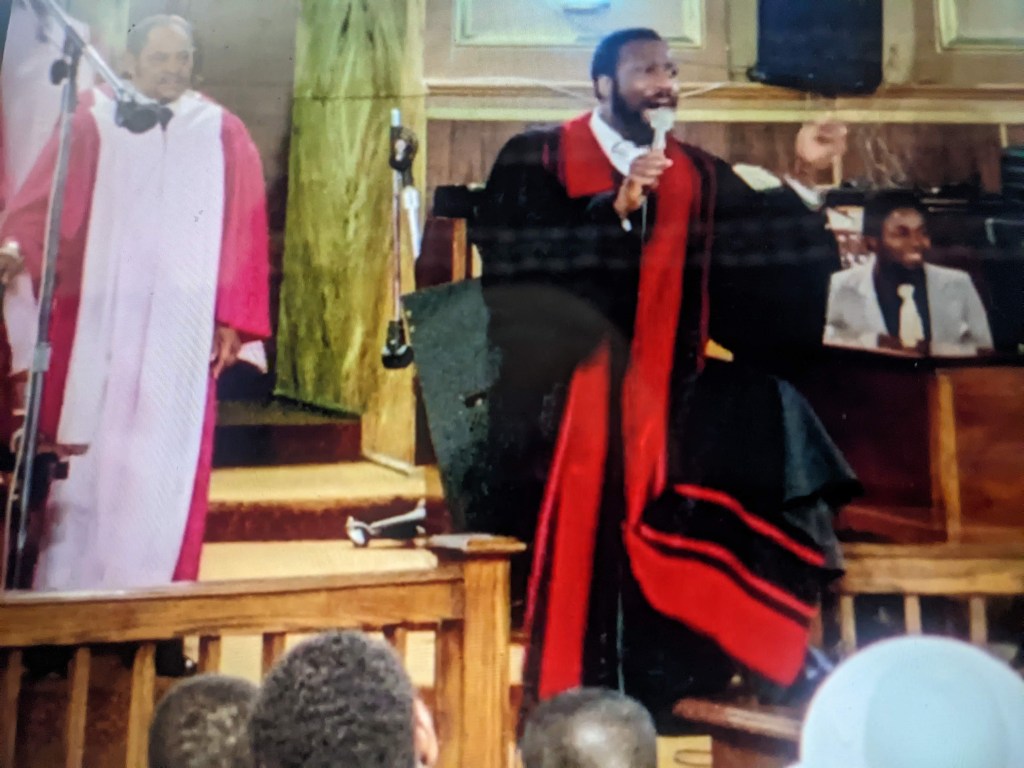
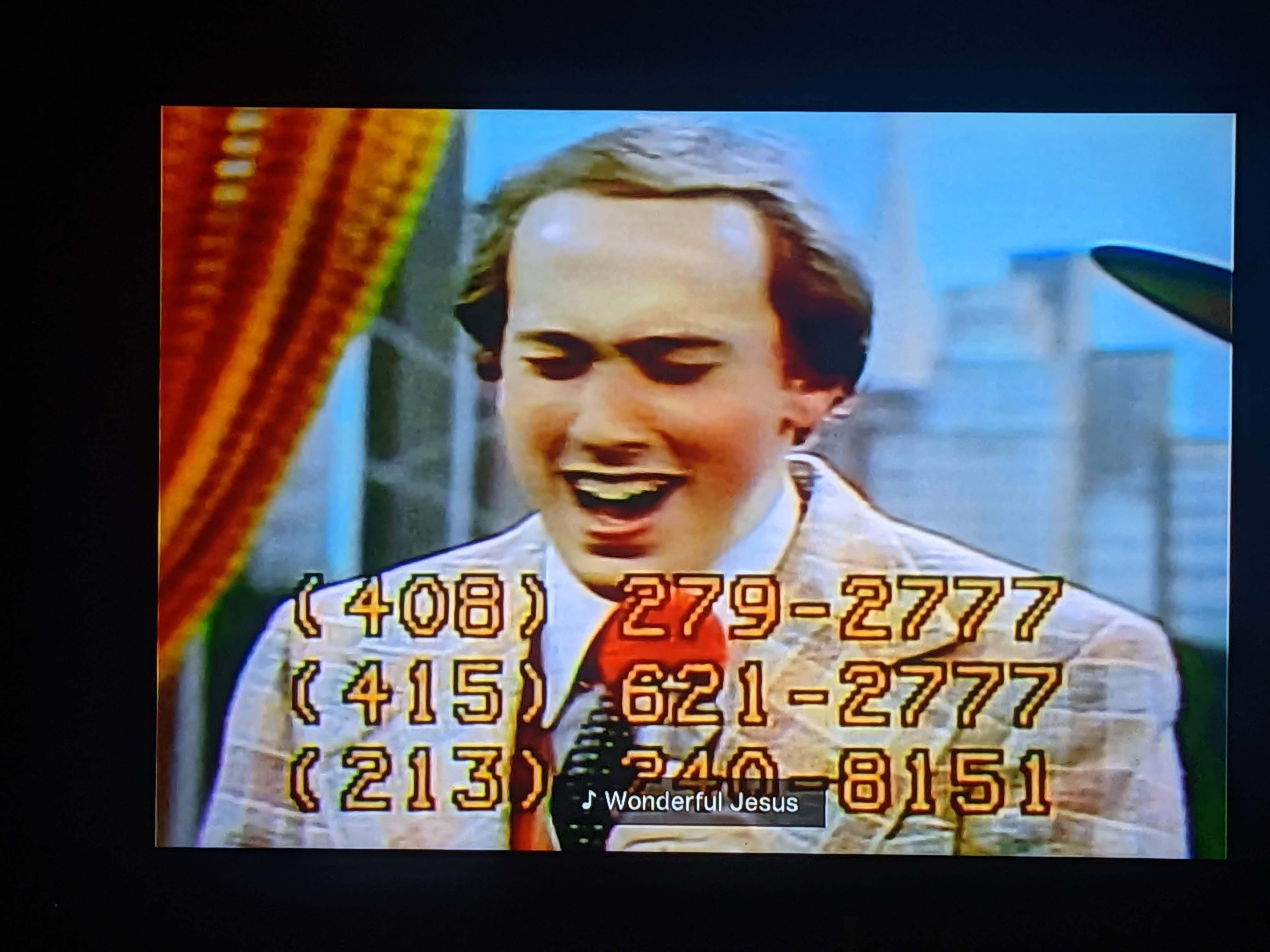
East coast vs. West coast Christianity.
I like to think of the impressions of Americans to a German audience in the early 80s, when watching these films. In Germany, a country divided into an east and west themselves. It was a time of burgeoning social change, with both uprisings and peace movements especially in anti-nuclear and anti-NATO activism.
I can imagine a German audience, gawking at the screen as Herzog in stern narration tells us that Pastor Dr. Gene Scott is a person who has multiple lawsuits at once: about embezzlement, a charge from the FCC, libel, tax battles.
Dr. Scott was a pioneer in the American phenomenon in the solicitations for donations. Staring sternly and directly into the camera, his voice wheedling out between thin lips, urging viewers “to hang your body on the line” to keep the station and church membership program running. The personal relationship with God is emphasized, as God’s access to one’s pocketbook, with the church as broker-dealer.
Dr. Scott was pastor of the Faith Center in Glendale, California, which had it’s own Faith Broadcasting Network, the first Christian television station and the first to provide 24-hour Christian programming and a nightly program, Festival of Faith. Certainly this was one of the programs that paved the way for contemporary mega-churches in 2022 Christian-nationalist USA. One can imagine the chubby congregation members chewing on TV dinners in their affluent suburban living rooms, writing out their checks.
Contrast this to the nearly unnarrated footage of a sermon by the Rev. Huie L. Rogers, at the Bible Way Church of Our Lord Jesus Christ in Brooklyn. The reverend’s preacher fire is nearly spell-binding and trancelike in his performance, where he himself seems to be swept up in the fire of the Lord and he is taking the whole congregation with him.
The sermon sweeps from societal commentary to Rev. Huie stirring up the congregation, running through the pews and jumping on chairs. One can feel the power of his voice, and the rhythm he generates. It’s an exquisite performance and choreography, of call and response and the backing organ. The fervor is a sight and sound to behold. Note, the sermon is of its time, and is rather homophobic and transphobic.
While the entire documentary’s camera is trained nearly exclusively on the reverend, at the end we exit the church onto the rainy streets of a low-income neighborhood in Brooklyn, onto a street with boarded windows, a bare mattress in a building entry, and nothing visible of life on the streets. The Life seems to be the Church itself, in the congregation, and amongst all the community gathered there, and the reverend as glue holding everyone together.

Despite the contrasts of white and black, urban and suburban, and relative affluence and poverty, in both films we witness the age-old form and function of the church, in creating ritual to enforce social order.
 Herzogian