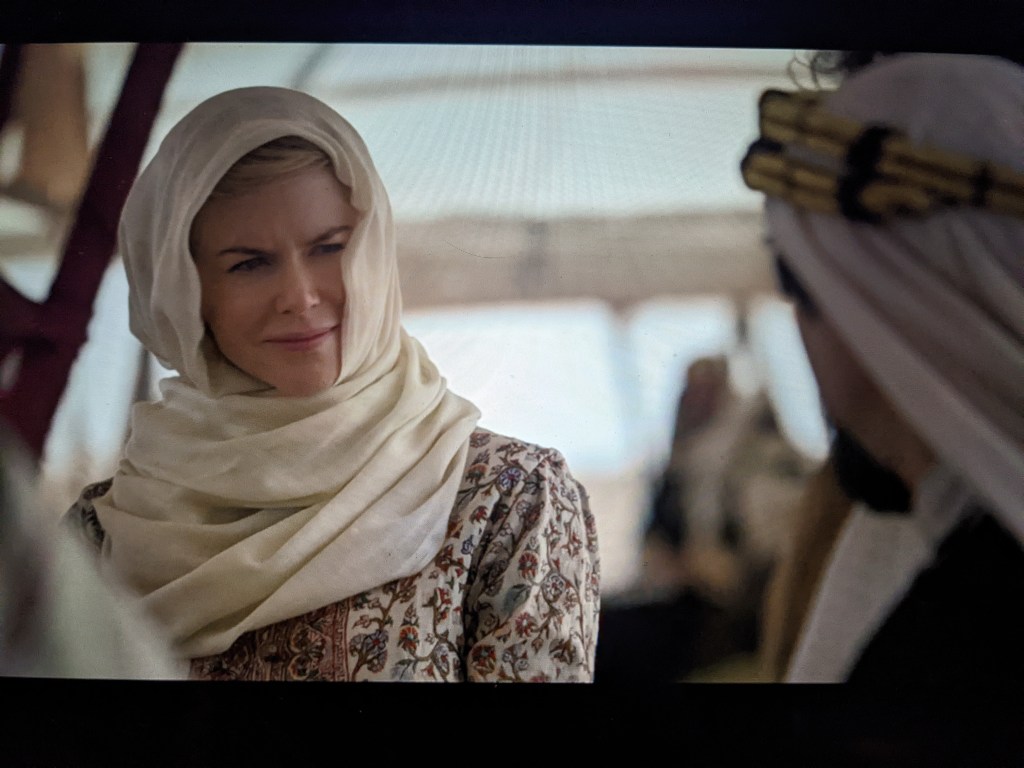
I didn’t expect to like this movie so much. On one hand, it’s a colonizer’s eye view. On the other hand, it’s just Herzog herzogging out in the desert, and taking us from Tehran to Damascus to Cairo, and letting a unique lost love from history come back to life.
As Queen of the Desert, Nicole Kidman plays Gertrude Bell, an explorer, diplomat, and political figure uniquely positioned as one of the sole women involved in the formation of contemporary Arab states. In her time, she advocated for independent states and tribal sovereignty and autonomy, in opposition to the many men who used the world as a chessboard. Historical process and contemporary political opinions aside, Bell’s life is compelling, and it makes total sense that only an actress as seasoned and powerful as Nicole Kidman could play her.
Nicole Kidman is pretty damn admirable in this film. She is plagued by men yet tortured by a dangling carrot of love. In our first view of Gertrude Bell, she is exasperated by high-society parties, awkwardly playing a younger version of herself learning Farsi from James Franco. While the settings are lovely, ya kinda just have to sit through these parts. It gets much better. As the story progresses, we find a more seasoned Gertrude holding her own on camelback and going off to face the Druze. She befriends Lawrence of Arabia (played cheekily by Robert Pattinson) and survives what seems like several impending forced marriages. She lived the rest of her life among her chosen people, and died in 1926 in Baghdad and is buried there.
This part of Gertrude Bell’s life is barely mentioned in the film, so if you are reading this and you don’t already know Hafez, you’re welcome: Gertrude Bell translated much of Hafez, the West may not have so much of his work without her.
You can open Hafez anywhere and be covered in the rich honey wine of his words.
Hafez is the most popular poet in Iran, and his works can be found in almost every Iranian home. In fact, October 12 is celebrated as Hafez Day in Iran.
Many Iranians use Divan of Hafez for fortune telling. Iranian families usually have a Divan of Hafez in their house, and when they get together during the Nowruz or Yaldā holidays, they open the Divan to a random page and read the poem on it, which they believe to be an indication of things that will happen in the future.
https://en.wikipedia.org/wiki/Hafez
Yaldā Night is coming up on Wednesday, December 21. With intention, I plan to open my Divan of Hafez and ask what this next year will bring.
Update: Just a note that an amazing documentary about women nomads is Women of the Sand, free on Kanopy. Watch it! -12/5/22
Update #2: I recently started a reading a page-turner of a brick of a book: The Great War for Civilization: The Conquest of the Middle East by Robert Fisk. I am already thinking it’s essential contemporary reading about the region from a Western view. Fisk, who is English, was the only Western journalist to interview Osama bin Laden. The initial meeting was brokered by the late Saudi journalist Jamal Kashoggi. The facts about the world’s most infamous terrorist are super interesting. The American wars in Iraq and Afghanistan began when I was a teenager, and certainly my view was limited in some news. But I never knew some facts that completely make sense about bin Laden, that he was an engineer who built extensive roads in northern Afghanistan and also in the Khartoum region to Port Sudan. While some sources say bin Laden skipped out on debts and never finished the road, Fisk characterizes that bin Laden was revered in Sudan for shortening a road from 1200 to 800 km, making the trip actually accessible in one day for a major city to the regions largest port. It’s just these details that make the layers in our history and in our world more nuanced, interesting, and when they are obfuscated beneath dominant narratives, maybe these details ensure that what we read as history becomes more true.
Note on some new sources of historical context, in just minutes of duck duck go research I found the following which may interest readers on their own. This is just a link dump, there’s no way I could process and synthesize any lessons from this cursory research, so drop more ideas, thoughts, wisdom in the comments:
a 1989 World Bank PDF about the importance of the road and some background on Sudan. It also details backlog problems about the port that would be solved with the road.
Two 2020 articles about protestors blocking and subsequently agreeing to re-open the road , the other article about the protests is here.
Another rabbit hole, but this Middle East Eye article from 2022 shows the US state department influence in Sudan by blocking visas for people involved in any government opposition. My ears perk up at knowing what are the US/imperialist interests? What narrative are they pushing? How do events become popular, and how does that influence popular opinion here in the US? – 12/24/22
 Herzogian