Around the midpoint of this year, I embarked on a low-key Herzogian quest: to watch all of Werner Herzog’s films by the end of the year.
I had a dozen or so Herzog films under my belt, mostly documentaries made in the past two decades. Something snapped inside me earlier this year when I watched Nomad: In the Steps of Bruce Chatwin. Deeply enthralled and touched by several elements in the film, I searched for the soundtrack. I bought and gulped up Chatwin’s book The Songlines. I watched Nomad again. And then on another night, I watched it twice, back to back.
On Bastille Day, I was feeling wistful and romantic. July 14 happens to be my partner’s birthday, and he had just moved across the United States for an extended period. So alone and fidgeting, I came across Herdsmen of the Sun free on Tubi. In Nomad, Herzog describes bringing footage of the film to Bruce, while Bruce was on his deathbed. The broad smiles on the painted faces of the beautiful Wodaabe men, bobbing for height in a lineup on display for a potential partner, were some of the last images Bruce saw as he lay dying.
Last year, I became acquainted with the experience of a deathbed. A dearest loved one’s last words were left to me. The words were fully and confidently consciously aware and knowing, while simultaneously heartbreaking, and utterly brave. The experience was heart-wrenching, was something so final and visceral yet eternal.
It has changed me forever.
It has set me on a quest for a quest. I’m not certain if there’s something concrete I am looking to learn from Herzog here, I suppose it could be about this soul journey to a destination, about my journey, a more universal human journey. I’m determined now in a way I haven’t ever been in my life before, to perhaps be lucky enough to just brush against supporting the parabolic life force energy that I witnessed happen on the beloved’s deathbed.
I’ve always been a bit of a dreamer and slightly wandering but not wholly aimless. I am a regular person working a fairly regular job, who does quite interesting but fairly low-key art. I am not a film critic or anthropologist, and certainly not a writer. I am in a process of continuous learning for which I know there is something deep and purposeful to gather along the way. I care about the world and I respect the way Herzog captures humanity on film. I seek lessons from his art and the canon of his films that have established this elusive Herzogian hero.
At the time of starting this blog, it’s taken me a little over two months to watch 15 films, and I have 25 more to go on my list. I don’t “like” every Herzog film I’ve seen and liking or even fully grasping isn’t the point. I’m not watching methodically nor do I intend on writing this blog methodically. Maybe some posts will be like film reviews, but more so like vehicles for random research, random musings. I suppose I’m watching as much “for free” as possible but I’m also willing to eventually pay $12.99 for The Queen of the Desert on Xfinity, despite the slightly poor reviews. Today, I splurged $96 snatching up the web domain “Herzogian” when my thoughts could essentially be kept “for free” in the notebook that sits next to my TV in which I’ve been logging entries on the films I watch.
My thoughts prompted by Herzog (and Chatwin, and other illustrious people in Herzog’s orbit) are more about drive, devotion, death, and aesthetic reverence. I am here to wander online about an artist I admire and hold dear, and maybe I’ll bump into fellow travelers over these Herzogian topics along the way.
Note on possibly copyrighted images: none of the images I’ll use on this site belong to me. Even though all my pics are going to be low budget and low quality camera phone pics of other people’s images on my TV. All the photos taken are of the film discussed in each post, so either belong to Herzog or the featured filmmaker in the post. If someone stumbles across this and I’m unintentionally violating copyright, let me know and I will fix!
This year is the fourth holiday season since my mother died. It’s been an exceedingly solitary holiday, so the sparse connections have been extra meaningful. Today, I was walking in a snowy park, talking to a friend about purpose. With her: in regards to her teaching career. Me: in relation to realized purpose in the days spent with my mom in her final days, and where I am now with walking the path of purpose.
I have been trying to read “Bardo thos grol chen mo” (The Great Book of Liberation Through Understanding in the Between aka “The Tibetan Book of the Dead”, Robert Thurman translation) for about 4 years now and I keep getting stuck. I have been stuck on the book, because I was in an arrested state of grief because I had yet been unable to pull out of a significant life area where I was stuck. But a few days ago, I took it off the shelf and spent some days with it.
Last night, with transition states toward liberation in my mind, I put on Wheel of Time (free on Tubi!) before going to sleep. I am grateful to witness aspects of devotion with refreshed vision.
Then, this morning, I felt a rush of inspiration to read, making meaningful progress in the book. This felt of monumental importance because:
The text is foundational to supporting people in hospice
Getting past a place in the book indicates I am getting unstuck.
I’m getting unstuck from habitual patterning.
Romantically, this has been the most up-and-down I’ve ever been. I’ve been lucky to have bids for romantic connection directed at me recently. In past years, I was caught in patterning that used romantic connection as one might use a weighted blanket: keeping myself insulated from my deeper self. The insulation kept a part of me in an arrested state of grief.
Over this year, not out of my own will but rather an involuntary reflex, I pushed away romantic connection. Over the year I realized my spirit was keeping distance out of necessity for growth. This process has been difficult. I have made mistakes, caused hurt. Fighting ways out of the nets of patterning is painful. For me, if people can’t see their role in my net, if I can’t tell them. At this current moment, I see the net. I can swim around it now, and I see how to warn others about this net. I am hopeful for repair where possible, and most importantly, I want to move forward in life where I don’t cause pain again. Small steps, doggy paddling towards clarity.
My most significant leaps this year have been in new modes of expressive exploration. I danced via burlesque and butoh, I took a black and white film developing course, I explored photography and videography projects. I visited multiple areas of political praxis and at the end, came back to my original principles. Going into 2026, I can feel more confident in going deeper, sustaining time with projects. I spent Christmas Day deep cleaning, thus my physical and mental path is clearer today more than ever, which I think is the best I can ask for in this life. I have no resolution but (as a wise person told me this year) – to make the road while walking. I have intentions down the line that maybe involve continuing education, surely a career shift, and hopefully, intentional community.
This year, I’m building foundations. Clearing more nets through self-and-spiritual inquiry. Keep walking the path of service, God willing. I walk as a flawed but devoted servant of whatever exactly you put me here to do, however humble, God and Mother.
Herzog’s work remains a useful vehicle for threads of research and inquiry: Herzog is just so damn relevant to me personally. His work has supported my growth as a human being. Here are a few of the topics I will get down in pixel in the near future. If I was a better blogger, I would be writing these in real time, but, what is time.
Of Walking In Ice (Herzog walks from Munich to Paris to affirm the life of Lotte Eisner, I read it during 23 Nov – 14 Dec, the same days he wrote it 31 years ago).
Gesualdo: Death for 5 Voices – I rented a DVD player from Kim’s Video in lower manhattan, was so thrilled, only to see later that someone had indeed ripped it to YouTube. However, the process of getting the player, and finally watching the DVD that I have held on to for 3-4 years, was amazing.
The Peregrine – this was recommended via the man himself via his documentary filmmaking Masterclass, which I completed this year, lol. So I read it, and it’s very Herzog – it has this moment of intensity that is worth trudging for.
Popol Vuh (the band and the sacred book and about creation and origin historia in general)
Expanding Consciousness and Navigating Modernity – This topic may also expand on musing on if Herzog’s teachings are some stand-in for a relationship with my estranged father (getting Freudian!!!)
“The spirit of enlightenment of love and compassion is the energetic and cheerful aura you create for yourself by shifting the orientation of your life away from self-preoccupation to preoccupation with becoming an enlightened being in order to bring happiness to all others… at the conclusion of this meditative process, you lock in the ambition with the vow to serve all beings. The spirit of enlightenment is all a matter of orientation and determination.”
I don’t want to share any images from The Act of Killing here, go watch it on Tubi!
Watching the most recent iterations of political violence unfold in America has prompted me to turn to history. How did people and groups seeking social transformation respond to and survive counterrevolution via targeted mass political violence?
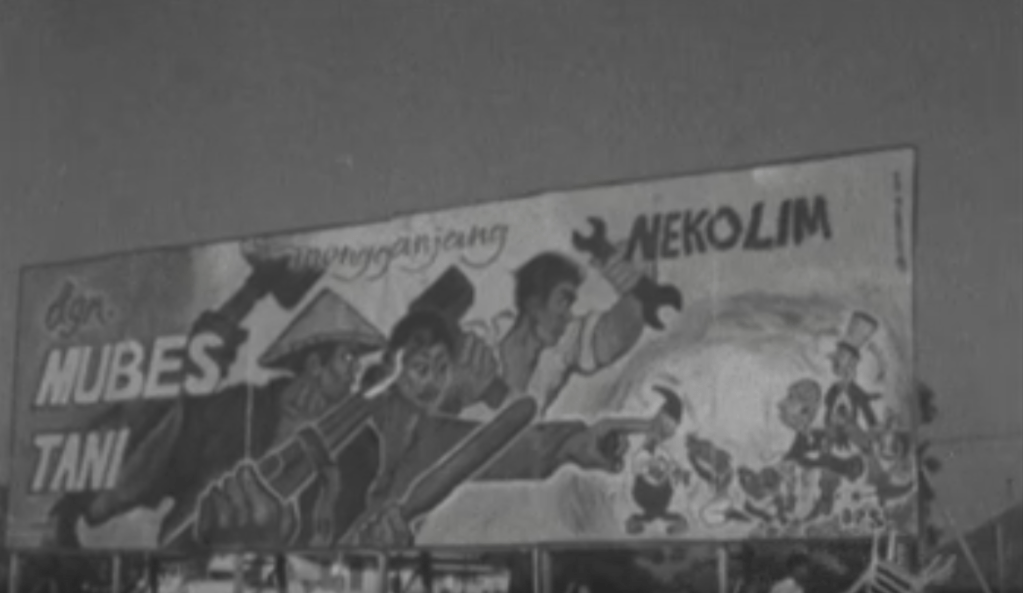
Comparisons have been made of our current moment to several time periods, all with important lessons to draw from. The German Revolution saw an uprising of workers and soldiers who wanted to bring about a Soviet-style government, but the ensuing battles and loss led to the establishment of the far right Weimar Republic, the predecessor to Nazi Germany. The Years of Lead in Italy which were characterized by multiple acts of violence of far-left vs. far right. These warrant further study but now I want to turn into the lessons from Indonesia in the 60s which stands out as a place to study more closely because of the complete and rapid decimation of the Left via two means: effective nationwide anti-Communist messaging, and various gangs that carried out purges with weapons supplied by the Indonesian military and the CIA.
In the 50s and 60s, a long struggle for independence from colonization was finally taking shape as self-determination in various local reforms. After being ruled by the Dutch East India Company, the Dutch, and then the Japanese, programs to reform agriculture and trade to benefit plantation workers, peasants, and poor people were taking place all over the country. In North Sumatra the SARBUPRI, Union of Plantation Workers, were rallying for basic living standards. The Indonesia Peasants Union in Java and Bali sought agrarian reform and landlord resistance. Local struggles under various banners were consolidated under a large alliance called Nasakom, a term coined by the first president of Indonesia, Sukarno, who won the county’s first election in 1960.
Nasakom stood for nationalism, religion, and Marxism, and was at its core, an anti-capitalist and anti-colonialist ideal that sought to model the national government functions after more traditional local village consensus models and self sufficiency, that formed into an ideology developed by Sukarno called Marhaenism. This ideal was aligned with Soviet style functions, thus decades around this period saw the growth of the Partai Komunis Indonesia, or PKI, which in the 50s became the largest non-ruling Communist party in the world. The scale of the changes and new government struggled – it was a difficult time marked by reduced capacity of factories, low export revenue, and high inflation.
This was all during the Cold War, a global rivalry with the United States and Soviet Union. Sukarno was moving trade and investment away from Dutch-aligned countries including the US and Britain, and thus partnering more with China and the USSR. However Sukarno’s vision was ultimately more local and nationalist and was communicated globally. His efforts to ally with other nationalist and post colonial governments led to the Bandung conference, a meeting of 55 mostly African and Asian countries that for the first time pledged economic, political, cultural, and social alignment and support to each other, and was a basis for the Non-Aligned Movement, an eventual formation of 121 mostly developing countries that did not want to align fully with either the US or USSR led blocs.
A rival formation with a different vision for Indonesia was emerging at the time, out of grievances as a result of reforms. The army was losing influence due to more support and emphasis for the PKI and alarmed at Sukarno’s support for the PKI’s wish to quickly establish a “fifth force” of armed peasants and labourers. Muslim clerics, many of whom were landowners, felt threatened by the PKI’s rural land confiscation actions. Adding to this desperate and fractious nature, a split within the military was fostered by Western countries and the CIA backing a right-wing faction, against a left-wing faction backed by the PKI.
On September 30, 1965, a group killed 6 generals in the military and 6 other soldiers. The group said they were pre-empting a coup attempt, and thus took Sukarno under its protection. A general in the army, Suharto, led the effort to quickly blame the PKI. Graphic images and descriptions of the murdered, tortured, and even castrated generals began to circulate the country. Suharto ultimately presented it as a Sukarno-aligned nationwide conspiracy to commit mass murder of Muslims. Millions of people associated with the PKI, even illiterate peasants from remote villages, were presented as murderers and accomplices of the movement. In Walden Bello’s “Counterrevolution, “the PKI was associated with these two words: penghianat (“traitor”) and biadab (“savage”) and action was swift. By October 8, the PKI headquarters in Jakarta were burned down. Thousands of members of PKI student groups were arrested. Suharto secured a presidential decree which gave him authority to take any action necessary to maintain security.
What followed is what Bello called this mass killing “eliminationism,” where the range of the massacred is disputed but is between 500k to 2 million.
“In contrast to Italy, where the security agencies and the bureaucracy let the fascists take the leadership in wiping out the left, the army had an indisputable leadership role in the 1965–66 massacres in Indonesia. Most accounts agree that this was a veritable case of counterrevolution from above carried out principally by the army. Without army leadership, the personal, socioeconomic, religious, and cultural tensions that fueled violent fervor would never have resulted in mass killing and incarceration on such a wide scale.”
“The military signaled ideologically motivated militias to kill local Communist rivals. Given the fact that the military’s capacity was dwarfed by the geographical spread and population of the Indonesian archipelago, the role of these militias in carrying out the army’s master plan was indispensable.”
Communists, red sympathizers and their families are being massacred by the thousands. Backlands army units are reported to have executed thousands of communists after interrogation in remote jails. Armed with wide-bladed knives called parangs, Moslem bands crept at night into the homes of communists, killing entire families and burying their bodies in shallow graves … The murder campaign became so brazen in parts of rural East Java, that Moslem bands placed the heads of victims on poles and paraded them through villages. The killings have been on such a scale that the disposal of the corpses has created a serious sanitation problem in East Java and Northern Sumatra where the humid air bears the reek of decaying flesh. Travelers from those areas tell of small rivers and streams that have been literally clogged with bodies.[60]
—Time, 17 December 1965.
The current state of the Left in the US comes nowhere close to the scale of Indonesia’s Left. Any social gains in the US, if we can call them that, are municipal – tiny and relatively marginal compared to the scale of national crumbling of jobs, housing, health, and education. There is no widespread social reform, there are weak crumbs like the liberal identity based corporate concessions like DEI. Our most recent national election, in the words of Chris Hedges, was a choice between oligarchs and corporatists, and the oligarchs won. The corporatists are falling in line. And the strongest games in town in terms of local social reforms, such as New York City’s Zohran Mamdani and Minneapolis’ Omar Fateh have platforms of bare minimum programs that are indeed desperately needed to relieve widespread poverty, yet these candidates are being erroneously characterized as radical Islamists and Communists.
These days, Stephen Miller aka lil Goebbels, said: MAGA “patriots,” have inherited a civilizing mission from their ancestors. To continue this mission, save humanity, and continue the legacy of [Charlie] Kirk, he said, they must vanquish the “forces of darkness.” They mean every one of their political opponents, from the wide range of black bloc antifa to Elizabeth Warren voters.
The far right-wing and fascist narratives are that anti-Christian and anti-white bias actually exist. So what does this mean for our communities? What will American pogroms look like? Indiscriminate, just like the american attention span? More school shootings? Lone gunmen? The targeting of migrants, Gaza activists, environmental defenders, dissidents of every kind. What about dems in rural areas? The framework for mass repression is already realized in the entire framework of American prisons, jails, homeless shelters – these are the blueprint. The American Counterrevolution has been in place for 100 years. The historic decimation of labor unions, against social reforms and liberation struggles from the red scare to the takedown of the Black Panther Party and militant black power groups, are all part of the sustained war on insurgents and rebels.
In The Act of Killing, which Werner Herzog produced, we follow the director Joshua Oppenheimer as he follows several former commandants of the 1965 death squads.We follow these emotionally damaged buffoons who were, at the time of filming, in positions of power in the army and local towns. They intimidate families and shake down shopkeepers. The documentary is somewhat unique in that it pure observation, in a doc like this you might imagine historical photos, images, or newsreels. Oppenheimer simply drops you in with these “winners” who want to be movie stars, as they do live re-enactments of their mutilations and mass killings. In the process, we witness the totality of their emptiness, the scourge on the human soul that the act of killing creates. I imagine it’s the same emptiness that will haunt the ICE agents of today, who otherwise seem to be ripping families apart with glee. (I encourage readers to watch the film, available free on Tubi).
Resistance to all of this has already been messy and difficult. With maximum charges, terrorism enhancements for antifascist, environmental, and community defense actions. What comes next requires trust, faith, and love.
This love is what drives community based social projects, these are at their essential form survival programs in the face of failing infrastructure, social services and political system. These survival programs are community self-defense against fascistic forces. What makes antifascist community self-defense revolutionary is a commitment to long-term broad social transformation: the revolutionary horizon. My personal belief system, but perhaps not my practical capacities, tell me yes, we must work towards this at all costs. Given the odds, will we ever get there? I’m inspired by the recent film One Battle After Another. While I don’t consider this a revolutionary classic such as “The Battle of Algiers”, the network or highly organized cells is what fighting beyond survival looks like. It’s a thread of love and devotion to each other’s long term survival, each other’s children, that’s going to get us through whatever the next few years of
The battles we have to keep fighting will be less thrilling than the movies. We must do everything we can to protect our neighbors from ICE, getting each other to basic healthcare appointments, and after school tutoring programs so parents can work. This type of everyday antifascism rooted in community self-defense is the only way many will survive the coming authoritarian dictatorship. Otherwise there will be battles – and if the military and militarized forces and militias are firmly on the far-right, we can look to the lessons of Indonesia to teach us what the absolute worst imaginable horror of it looks like.
In future posts, I’ll be sharing my research and lessons of militant resistance from the German Communist Party, the KPD – many of whom hail from Herzog’s home: Bavaria.
“If the grand promise of the internet was to be whoever you want, in reality it will make of you whatever it wants,
and beneath every mask is another mask, mistaken for a face.”
– From “Rejection,” Tony Thulathimutte
About a month ago, Werner Herzog joined Instagram. A friend sent me the post, showing what appears to be a lush backyard and Werner proclaiming his presence and announcing a window into his life. I am sad because I do not have Instagram, and therefore cannot participate in the wonderful fandom potential.
In 2021 I went decidedly off social media except a brief revisit about 6 months ago, when I joined TikTok.
Back then I felt as if I was getting left out of conversations – in reality I was just hanging out with my chronically online coworkers too much. One of the national conversations I wanted to take part in was “Love Island USA” (Team Nicolandria!) – a bunch of mainstream-hot 20-somethings with low emotional regulation skills imprisoned in a beachside villa was fun in the handful of episodes I watched. The real fun was on TikTok – a rollercoaster of reaction clips and analysis, all with hundreds of hours of cumulative engagement and views. Team Nicolandria wasn’t just a hashtag, it felt like a community.
After just lurking and giggling for a few months, around June I went from liker to commenter to poster to Content Creator. I figured out a formula of TikTok posts, the comment-and-like game. I think as a TikToker, I “performed decently” for the amount of time, effort, and subject matter I engaged in. I found a niche and a groove, and I replaced my morning journaling with a morning scroll. I looked forward to likes. I considered re-joining Instagram. The flashing lights of “Micro-Influencer” sparkled before me.
Kendra is a white woman, thirty-something, who went exceptionally viral in one day. She posted in a 12-part series of how “I fell in love with my psychologist and he kept me on as a patient.”
I have no comment about Kendra herself, her psych, the action of posting, the AI component, etc. It’s the attention to the matter that got me. Within hours, I – and millions – had watched and swiped past multiple satires, weighing-ins, reaction posts, and multiple TikTok psychiatrists and evenn psychiatrist wives weighing in. It was called by someone “the first AI induced psychosis playing out in real time.” Me and millions just … kept watching. I was fully immersed along with thousands of others who were emotionally investing, clicking, commenting, picking a side, and grifting. Everything else in life slipped past me for the better part of 48 hours. By the end of Day 2, I felt dead inside.
So I turned to something that had been sitting on my Netflix shelf for years: “The Social Dilemma.” Released in early 2020, right before we were all locked down and gradually became locked in online, it features interviews with multiple architects of our current usage: the inventor of infinite scroll, the engineer behind haptic feedback, multiple former Google employees who now run their own companies or nonprofits. The only thing you really need to hear from the film: while all of these people had a hand in designing the addictive little lightbox, none of these peopleallow their own kids on social media with highly regulated screen time.
“It’s the gradual, slight, imperceptible change in your own behavior and perception that is the product,” says Tristan Harris, a former Google engineer. At the cumulative scale – how has our mass behavior changed? It’s easy to see mass apathy as we are neutered as a collective force. Online, being political can feel like a community – so what happens when the community is redirected? What slid off the collective radar that day? In the same few days as the Kendra thing, famine raged in Gaza, the latest humanitarian flotilla was detained, and battles to protect neighbors from ICE were happening all week in Los Angeles. Those are the perceptible shifts – what’s the imperceptible shift? How is our attention being tracked, predicted, and controlled? How is our relation to community influenced and altered by our online-ness, but at a mass scale? When you’re online, you feel immersed. When you keep online interactions at arms length, you see the psychosis more clearly. It’s like being sober at a nightclub.
Aaron Swartz, a prodigy, genius, and activist using his time behind a keyboard championing open internet and free information, had trumped up charges that led to his apparent / alleged suicide while in FBI custody in 2014. Instead of keeping a high salary job with a tech company, something he easily could have done, Swartz was working towards more egalitarian use of the internet, free of corporate control. In the years before his death, he played a key role in stopping SOPA, the Stop Online Piracy Act, which was essentially an act that would enable corporate control over search engine results and criminalize file sharing.
In Lo, Herzog visits the creation of the web, addiction, trolling, medical refugees, and asks existential questions AI. In an interview shortly after making the film, Herzog said “We overlook how vulnerable all this is, and how we are losing the essentials that make us human.” The interview details the origins of the film, which is quite different from much of Herzog’s filmography – this wasn’t his idea, and he was initially resistant. He was approached by an executive producer who is an executive at NetScout, a cybersecurity behemoth Big Tech institution that has built the very world that Aaron Swartz fought against – for example using cyberattacks and hacktivists, with services that are tools against threat actors, sure, but also against collective direct action on the internet.
So, what has happened to our humanity since that time, say, from when SOPA was defeated? TikTok didn’t exist at the time of SOPA, and the COVID-19 pandemic hadn’t happened yet, and people weren’t using ChatGPT to write suicide notes. Being online was decidedly less extreme.
In years previous, you could feel a beam of pride that your online content could be viewed online by anyone anywhere and you could be totally anonymous. Now, your content and views and opinions are equally likely to be viewed by absolutelyno one or worse, viewed and completely ignored like too often a person sitting on the sidewalk asking for change. The wall of the screen is no longer the anonymizing force. Expressions online have real life consequences – from the payload salaries of the Influencer industry, to being fired from your regular job. As authenticity has become a popular commodity online, the formerly highly curated persona is now closer to our real selves now more than ever. Our legal identities are easier to track and dox, and tech companies working with law enforcement know exactly who we are. Amid it all, AI is more realistic than ever, so everything is potentially fake now. It’s all quite maddening, and there doesn’t seem to be an escape valve.
Two recent pieces of media take a deeper look, at how the alienating force of being online has distorted our participation in real-life community, and thus how community itself is deformed. (Contains spoilers).
This is a collection of short stories technically, but it feels quite continuous. It follows several characters who are influenced by the online world to such a high degree that they are stunted and desensitized to authentic human interactions and intimacy. All the characters are connected online or IRL within a few degrees too. It’s been called “the first incel novel” – and it’s amusing, hilarious, entertaining, tragic, maddening, and disgusting. And if you’re NOT an online person, I think Rejection is required reading for digesting the very real psychosocial depths, the layers of agonizing minutiae of online interactions: from the revenge, apology, fakery, sincerity, reaction, obfuscation, misreads, trolling, typos, and consumption that especially Gen Z and Zalpha are absolutely entrenched in.
I’m not a huge fan of Ari Aster, I thought Hereditary and Midsommar were both unique but ultimately shock pieces. But Eddington was brilliant in its social observation of local politics and community life being shaped and distorted by online information, interpretations, and interactions. Parallel to the internal psychological warfare shown in Rejection, Eddington shows the consequences scaled to a small town.
Amid the wild cast of personalities, the most important character is one who exists is the real life world in the most real, raw, and vulnerable way: the homeless man. His murder signals the eventual breakdown of society: he is essentially erased in the film, a moment that both signals and results in total psychotic blitz to the social order: the lone gunman tries to enact his agency on the real world, gets impaled in the process, and survives just barely, his brain and reactions barely perceptible inside his very fragile and limp human body. While the others, who gave in to the online world to let it guide their real lives: the mother-in-law who ingested online tales and in turn became a politician, and the false prophet worshipped by the wife who then seemingly started a movement and a family.
The twisted clusterfuck of the plot and characters concludes in a brilliant final frame: the wide shot on the flood lights of the Solid Gold Magikarp Data Center. Amid the relatively petty and smallscale human drama and entire social media fueled chaos – the data center is the most significant entity in the landscape, the alpha species on the planet, and we will en masse be subject (and potentially rendered obsolete) to it’s whims, needs, it’s own interpretations, and mistakes. Like the Magikarp, it will be unexpected, and indifferent, only operating on it’s own logic without regard to ours.
So, what will AI’s whims and needs be? According to the report AI-2027 by the AI Futures Project, the scale and scope of where AI is going is vast, sweeping, and we are already on the train, the frontier is smashed. There is no getting off.
So the question isn’t “what do we want AI to be” but rather “what will AI want us to be?” And how will humanity, in the literal, creative, existential, and physical senses, survive that? What is predictable, and how can we individually and collectively prepare for it?
Is it even possible to opt-out of this? I feel no personal sense of elitism or wisdom from not being on social media. 10 years from now, social media history will probably be like a credit score – and my lack of current “social media credit history” will make me unworthy of jobs and bank loans and like, health insurance, in the grim, bleak, terrible future. In that future scenario, perhaps my only saving grace might be this blog.
…Or, maybe the future is chill, and at worst *I* will just be left out of many more “conversations,” and I can go kick rocks complaining while I never again get a date because I refuse to be on Tinder.
Oh well.
So here’s my letter.
Dear Mr. Herzog,
I imagine you will perform quite well on Instagram, your millions of fans are lucky to have you there. I will be so sad to not see this side of you. I’m sure you have a team and are insulated against the evils of social control that the plebs are subject to. I can’t imagine you get up in the morning excitedly looking at your like count, or stress over some oddly placed trolling comment. May all your interactions be quaint and novel and sweet, and your home far, far away from any data center.
-Lovingly tut-tuting, from the dim recesses of the ever-expanding connected world
In 2021, during the precipice of this current age of the internet, Neptune Frost was released, a dreamscape in film by Saul Williams and Anisia Uzeyman. It follows the resistance of a hacker community made up of refugees from coltan mines, against surveillance and authoritarianism. Those in the resistance greet each other with a coded phrase “Unanimous Goldmine,” where exact interpretation feels lost as the entire film’s script is sort of one long poem playing on computing language, but in it’s simplest sense: “love will reconnect us.”
In the film, Memory says “The machine is dependent on the human spirit… Technology is only a reflection of us – the drum is nothing without the drummer.”
There are many who will accept the AI future as inevitable, but outcomes are not endpoints predictable by the fingertips of white men. As Jaron Lanier and Glen Weyl write, AI is an ideology, not a technology. For the technology roadmap in AI-2027 to come to fruition, human ingenuity and cooperation are required and we can decide another way that uses AI for good or let’s the Big Tech companies use us for the sake of AI. Communities all over the world and the US are disrupting Big Tech efforts more concertedly and effectively than I can type these words: from the workers in offices to the communities near planned data centers. Whatever current and future resistance and supporting human flourishing offline, beyond AI and data centers, looks like – it is so much more powerful than the individualist ideology of the opt-out and the lone gunman – it is already proving to be collective, interdependent, and unified. Resistance has to grow to become active, agile, and participatory to keep pace with the power of Big Tech. Already, resistance goes where AI never can – because it is tactile, corporeal, and it contains a soul.
Years ago I was grieving the death of my mother and I made this site as a digital altar and pathway to express and externalize my grieving process through the language of Werner Herzog’s films. I wanted to feel connected to others in the universality of grief – everyone who has ever lived has lost their mother.
I also wanted a project, something with low commitment, with the separation of the computer screen, somewhere to be raw and anonymous, somewhere decidedly less vulnerable than a grief meet-up (which I also did plenty of).
While I honor my mother at the altar in my home now, spending time intentionally with grief is typically saved for special days. Getting triggered into sudden grief happens less and less.
Still – events around my mother’s death was a major pivot point in my life. The lessons learned then propel me: lessons of going deeper into embodied empathy and devoted cooperation.
I think often of scaling up empathy and cooperation in ways that foster collective flourishing, but I’m a communist in a capitalist hellscape. Sometimes efforts of my day job or volunteer projects inch towards realizing that dream in my little corner of the world. At a larger scale, that dream feels utopian and naive as the world as we know it rapidly churns toward increased inequality and war, inattention and reactivity, exploitation of many because of wealth hoarding by the few.
With work spanning nearly 60 years, Werner Herzog has been an artist at a unique time in human history. Whether towards a penguin or a person, Herzog has created a body of work that supports a deeply empathic worldview. I believe that Werner Herzog is one of modern humanity’s doulas – whether that hospicing is towards a birth into the modern age or toward some death – I’m unsure.
I am not a nihilist, I do not believe the world is going to end with a sudden stop – roll end credits. But 2025 has been tough so far, and the coming years will offer increased challenges for the majority of us. We will grieve plants, animals, and people; while we marvel at scale and human achievements. We will need to meet collective challenges with empathy and cooperation if we are to survive and many will not – for most it is a matter of privilege, access, luck, and time. Some of us will reckon in the land of silence and darkness, some of us will be pulling ships over mountains. Whatever we collectively have before us, not only will we face a Herculean effort – we must reckon with the unknown, we must allow our drive to understand to guide us. Navigating our grim future will require a Herzogian effort.
In the past few months, in some of life’s quieter moments, I have been re-engaging some of Herzog’s material, and writing again. So here I am, I think every few weeks I might put something here on this decidedly slow-paced corner of the Internet. It’s been 4 years since I’ve written on this site. I’ve paid $100 to maintain this domain annually. The site surprisingly gains a few subscribers every month or so, which is pleasant to see. Maybe some interesting conversations can happen here.
So if you’re here, thank you for reading. Here, your attention is a precious gift, not a product feeding an algorithm. What brought you here? How are you navigating where we are all going from here? Whether you add your thoughts to the comments or keep them internal or put them somewhere else, I appreciate the chance to share with you in this way.
Did I learn anything from having watched Herzog’s filmography over the past six months?
I had to load up at the end of this month, luckily over these holidays I had a few extra days off work to finish this journey.
As an artist myself, it feels nourishing to immerse in the works of an accomplished and internationally beloved artist like Herzog. I got to wax philosophical over Herzog’s fanatical repetition of philosophical themes, images, and music. I delighted in his absurdist works, such as Bad Lieutenant: Port of Call New Orleans, and Protection Against Fanatics.
I lacked some brain and time capacity to deeply explore all the roads one could take with Herzog. I didn’t write all the essays I wanted to, like about my double feature of Little Dieter Needs to Fly + Rescue Dawn, or a deep dive into the pathetic archetype and very German play Woyzeck, adapted into a super fascinating role for Klaus Kinski. I think I would like to leave that door open, perhaps for collaboration with another Herzog fan. I barely “publicized” this project, but my hope is: if this website lives on the internet, perhaps some fan will come across it and be inspired to watch a lesser known Herzog film just for fun, or for deeper study, or existential exploration. (When starting this, I was actually shocked at the lack of websites devoted to one of our planets greatest living artists.)
The whole project gave me some nodes of connection to my emotional world. When my mother died in 2021, I experienced this giant rush of trying to understand the enormity of what I witnessed. Herzog’s films gave me some deep meditative yet detached way to think upon these larger themes of existence without having to immerse myself purely in grief and sorrow after the death of my mother.
I also realized I had started this project on my partner’s birthday, Bastille Day. During 2022, we adapted our relationship for a primarily long-distance dynamic. My partner is one of the most driven and seriously purposeful people I know, and he has always been my hero. On one hand, this project was like some sort of stand-in for adapting to a much greater amount of time spent alone. So, spending time with Herzog replaced the time I would have spent with my boyfriend. Ha!!
The Herzogian hero has an inner, singular drive. I think of my partner. I think of my Mother, who during her life was my greatest love but in witnessing how she lived her life at the end, and in her death showed her true self, her incredible courage and sheer physical will that made her my hero, made me in awe of her. Herzog’s heroes awe-inspiring in they are deeply devoted to and fully immersed in their subjects, but have a type of humor and lightness amidst their devotion. A euphoria and ecstasy in the pursuit of their truest Truth. I think of Timothy Treadwell of Grizzly Man, but also the bell ringer in Bells From the Deep, and of Bruce Chatwin.
Herzog always finds the incredible people a part or adjacent to these projects that are enormous in scope and importance. Like Mark Anthony in the White Diamond, or all the eccentric scientists in Encounters at the End of the World and Cave of Forgotten Dreams.
While I feel like this phase of the project is capped off neatly, having watched everything available for streaming, I’ll likely procure the three feature films not available on streaming platforms and post about those later this year. Now, I do not feel I’m in a rush – it will be a joy to savor some more Herzog moments! My invitation, for whoever reads this: inbox me or comment, and perhaps we can enjoy these rarer Herzog films together in a watch party. 2023 goals!
Unwatched films:
Scream of Stone
The Transformation of the World Into Music
Gesualdo: Death for Five Voices
Handicapped Future
Mr. Herzog, if you ever come across this: what a gift to receive all you have done for humanity. By making so much of your work accessible on the internet, you have opened portals as mysterious as cenotes for individuals to explore enigmas, to wonder. To think upon expanding our biggest universes and going even deeper into the most intimate parts of our souls. Through your art, we get to time travel, and we get the chance to experience these collective human experiences in modernity, perhaps one step at a time we get closer to our ancestors. Your body of work is transfixing and transformational. Thank you.
I have no idea who to credit this original photo to, but I snagged it off the amazing Twitter account @ParodyWerner
My 59th Herzog film, and somehow fitting cap to my Herzog journey. The film is both a look at the fascinating kitsch of amerika and also a comment on the despair of the consumerist pursuit of the amerikan dream bought on credit. We also get a handful of classic Herzogian visuals;
Stupid chickens
Car driving in circles, also seen in Even Dwarfs Started Small: “The vehicle-in-circles scene was inspired by an incident that occurred when Herzog worked as a steward at the Munich Oktoberfest as a young man. Part of his duty was ensuring that drunk patrons did not attempt to drive their cars home, so when a drunk man insisted that he was capable of driving, Herzog got into his car with him, placed the steering wheel on full lock, then got out of his car. The man passed out and the car continued to drive in a circle until it ran out of petrol.
Auctioneers! It’s been too many months between seeing How Much Wood Could a Woodchuck Chuck, but I’m wondering if thats where Herzog sourced his trailer auctioneet.
After a little whirlwind of a holiday season, I find myself fighting off a cold or COVID, so I can’t keep my eyes open much longer, but Stroszek is a unique film amongst Herzog’s filmography. 59 films, all so piercing and surprising.
“The reason the stone fell was exactly for heaven’s sake.”
The arrivals of meteorites are messages from the heavens, and yet are totally by chance. The meaning that gets assigned to them are totally human, as they just might as well be walked over if humans did not find meaning in the arrival.
Meanings range somewhat from holy and sacred with the kitschy, in what must have been the most incredible world travel itinerary.
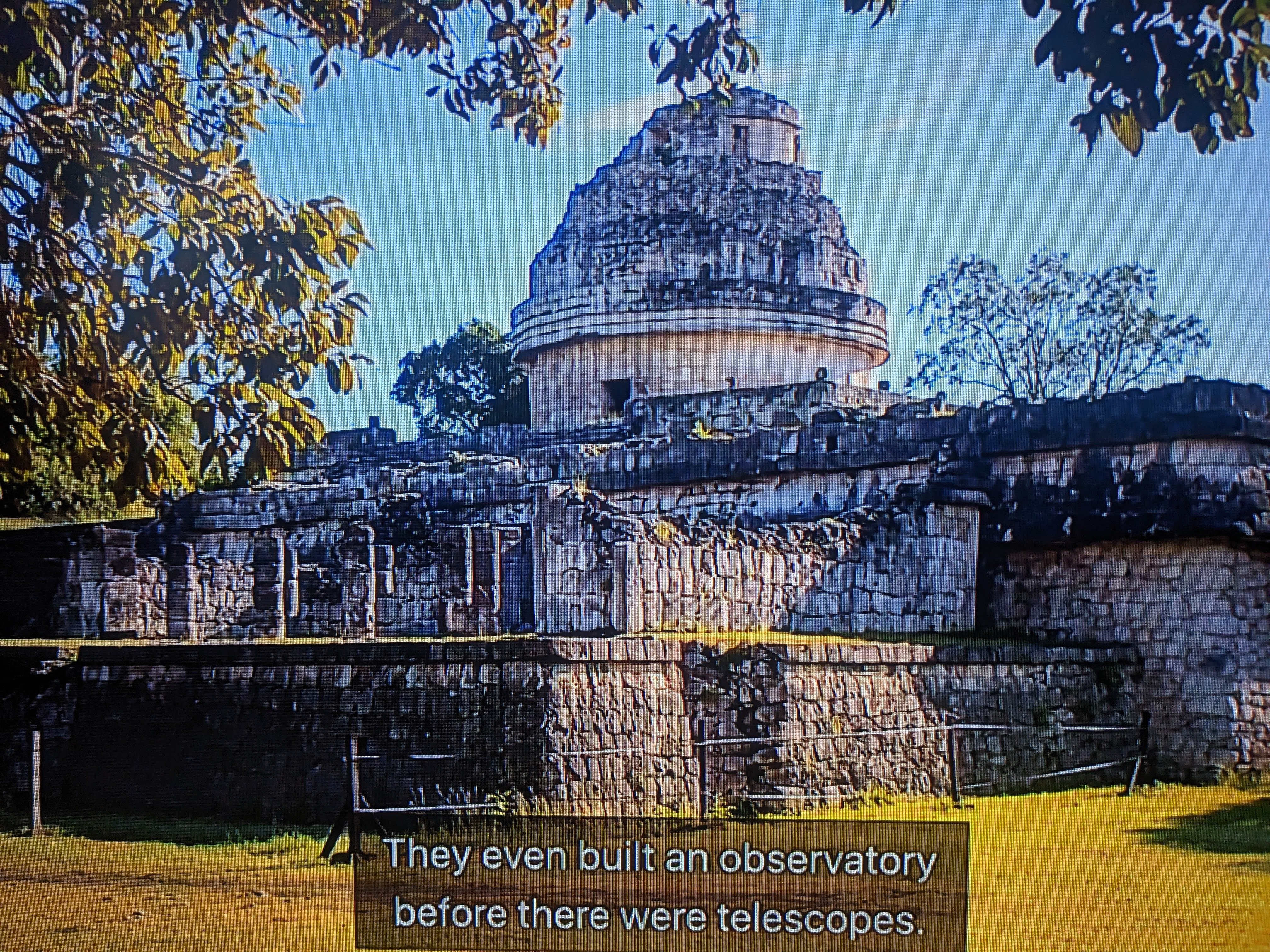
The holy include Kandimalal (Wolfe Creek in Western Australia). So incredible to watch the artist Katie Darkie trace her painting of the sacred crater site, and she explains that she camps with her family there every week to connect with her ancestors. A tantric temple devoted to Shiva and Parvati, where destruction seeds creation in a cycle of regeneration. The Maya temples and observatory, the abode of a rain God in a cenote, a portal to the underworld that exist as impact sites of the smaller meteorites.
The kitschy includes the Ensesheim meteor museum in Alsace, France, where a holographic miner, an amis de le meteorite. The world’s largest impact site, Chicxuiub crater, the meteorite that killed the dinosaurs and generated Geiger 11 earthquakes and 100-foot tsunamis.
The holy and kitschy seem to meet in the existence of quasicrystals. At first it seems like we are seeing a children’s puzzle, but we are shown something incredibly complex, in non-repetitive symmetry. These quasicrystals exist naturally in meteorites, and seem to be the origin for the creation of new minerals, signaling the origins of minerals on this planet.
A very interesting visit is to the Vatican’s observatory. The Jesuit priest speaks of the matter of belief and faith, what gives you awe in order to prepare to encounter a god. “You can’t believe in a god without experiencing wonder at creation.”
I watched this twice, the only clip I could find on YouTube has Portuguese subtitles. I thought with my elementary Spanish that I could follow along. At first it just seems like a documentary about horse trainers. About halfway/8 minutes in, I was confusedly realizing that I was watching something very very different, and quite absurd.
My second round, I watched with Google Translate lens in hand.
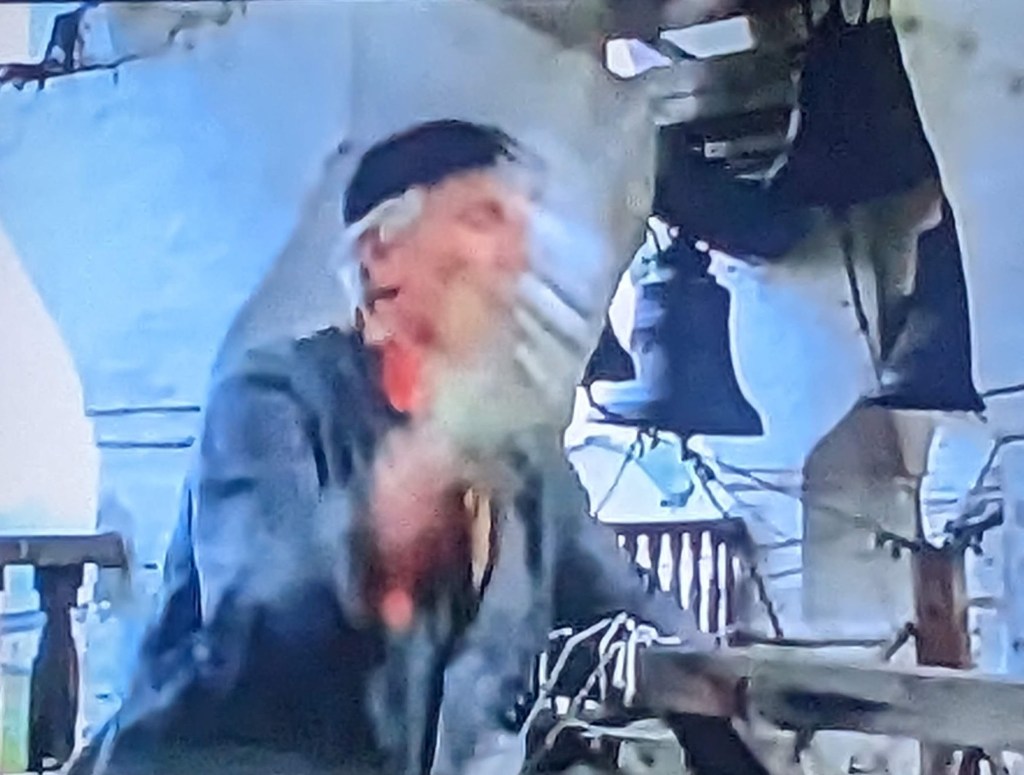
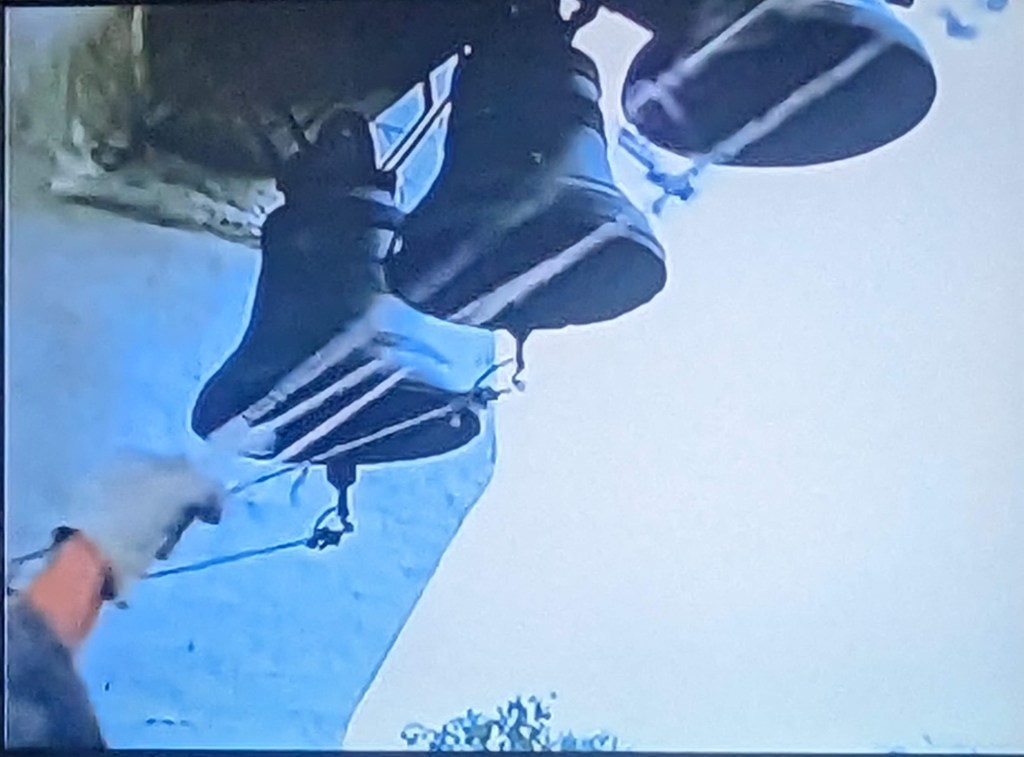
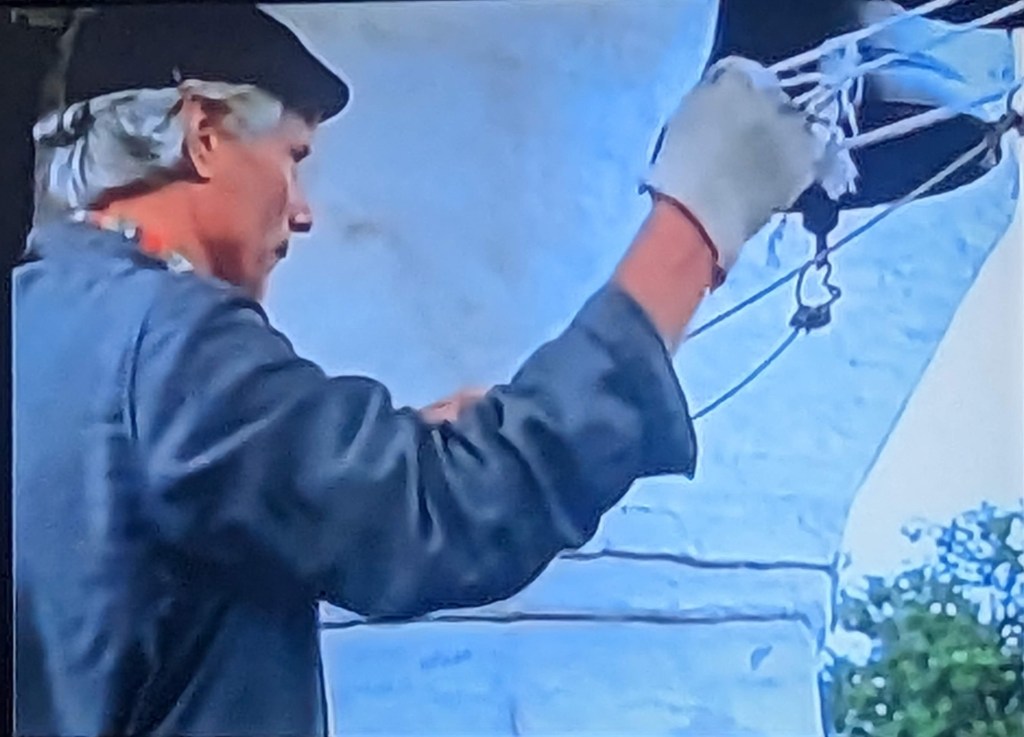
Are the bells the inner song of mystics, ringing out to bless our ears?
With scenes reproduced in Pilgrimage and familiar from Wheel of Time, Herzog takes us to see prostrations of pilgrims and rituals of a shaman, and a Russian Jesus, and a glimpse of the whole Russian soul on pilgrimage to a lost city of Kitesh. Also, you can’t be into EDM and not see the bell ringer that Herzog found. He’s amazing.
Overall, a transcendental documentary experience!
Throat singing is totally mesmerizing, below are a few selections from the Siberian region:
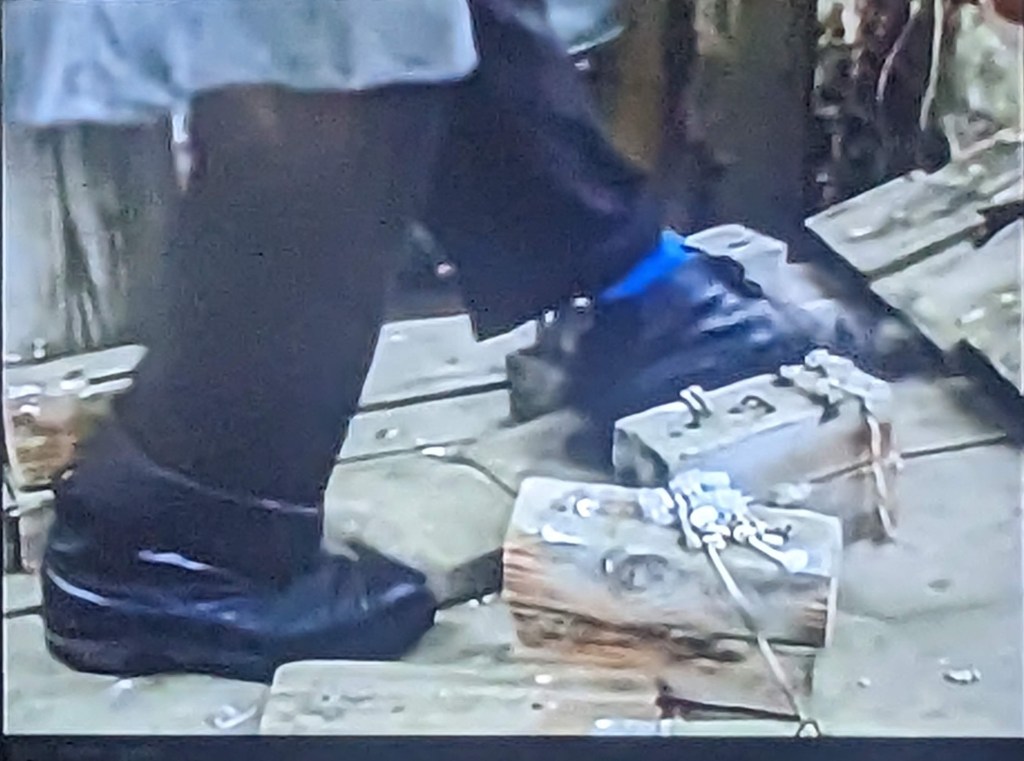
In keeping a vow to Errol Morris, Werner Herzog eats his shoe. He takes his boots to Chez Panisse in Berkeley, California and stuffs and seasons them, with Chef Alice Waters adding duck fat and rosemary.
Herzog promised to eat his shoe if Morris completed the documentary Gates of Hell. Herzog eats the shoe at the premiere at Berkeley’s UC Theatre. Herzog describes Gates of Hell as “The only film on love and late capitalism – the only film on loss, of degenerations of feelings, very purely done, and mature.”
Les Blank captures more of Herzog’s most fun thoughts: about how he hates talk shows, and how one must steal for art, and the inevitable process of becoming a clown, and being open to foolishness.
Lastly, this important quote: “Our civilization is going to die out if we don’t develop new images – I see it as a very dramatic situation.”


 Herzogian