In 2001, Herzog returned to fiction feature films after a decade of documentary, with Invincible.
Eric Hanussen was a clairvoyant and astrology who practiced in Berlin in the 1930s, and stirred up support for the Nazis. He was also Jewish. He’s written about extensively on New Dawn magazine, characterized as an unscrupulous man, he ruthlessly dreamed of expanding his Circle of the Occult to support his idol Hitler. I literally had to look away from the screen as Tim Roth in the first hypnosis scene, thinking if Herzog was actually trying to hypnotize viewers.
Zishe Breitbart is sweet and uncomplicated, a family oriented Polish blacksmith who runs away to the circus. Carries a quiet and stoic exterior, resists performing in front of a Nazi audience, having to play Siegfried the Aryan strongman (over whom the Nazis lose their shit over his displays of macho heroism). Hanussen tortures Zishe by abusing the pianist Marta in front of Zishe. By revealing his heritage, Zishe throws off the wig of Siegfried (nearly causing a Nazi riot) but inspires his fellow Jews in the process.
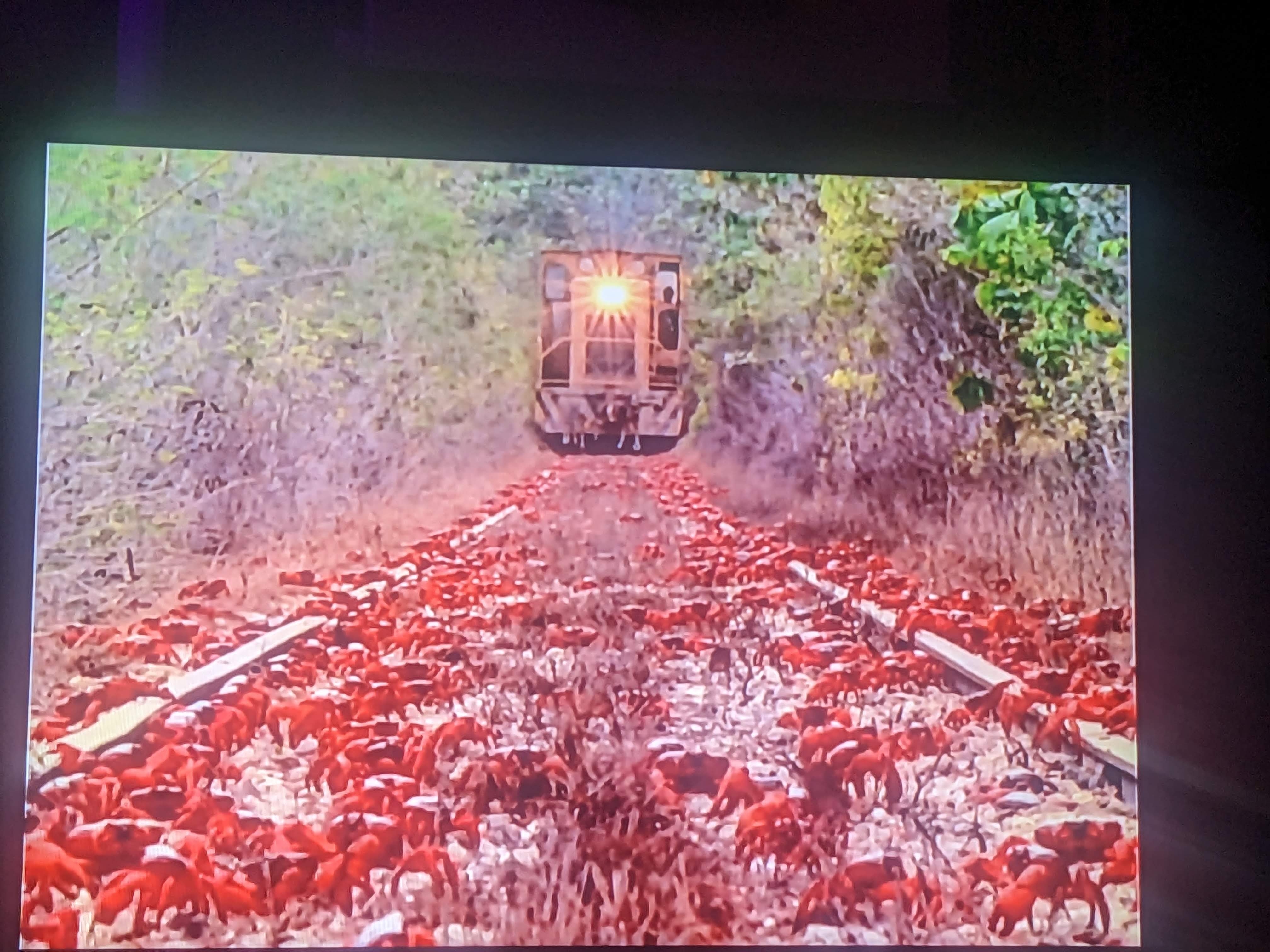
In the films most Herzogian scenes, Zishe is in a dreamscape near a beach, surrounded by red crabs, a train approaches that will inevitably run them all over. Hanussen dreams of being a center of power himself, with a more elaborate Circle of the Occult. Were these hypnotized crabs those who worship power, only to be run over an unseen oncoming force? (Folks may recognize these crabs from another Herzog film. Do you know which one? What do you think about the metaphors in each film? Drop a comment!)
Update 12/25/22 – Interesting throwback to Herzog’s first film, “The Herakles.” It’s a short film juxtaposing scenes of bombings with scenes of bodybuilders, and seems to be a comment on an obsession with strength and a show of force. Perhaps this comment is central to the German character that Herzog is exploring.
I didn’t expect to like this movie so much. On one hand, it’s a colonizer’s eye view. On the other hand, it’s just Herzog herzogging out in the desert, and taking us from Tehran to Damascus to Cairo, and letting a unique lost love from history come back to life.
As Queen of the Desert, Nicole Kidman plays Gertrude Bell, an explorer, diplomat, and political figure uniquely positioned as one of the sole women involved in the formation of contemporary Arab states. In her time, she advocated for independent states and tribal sovereignty and autonomy, in opposition to the many men who used the world as a chessboard. Historical process and contemporary political opinions aside, Bell’s life is compelling, and it makes total sense that only an actress as seasoned and powerful as Nicole Kidman could play her.
Nicole Kidman is pretty damn admirable in this film. She is plagued by men yet tortured by a dangling carrot of love. In our first view of Gertrude Bell, she is exasperated by high-society parties, awkwardly playing a younger version of herself learning Farsi from James Franco. While the settings are lovely, ya kinda just have to sit through these parts. It gets much better. As the story progresses, we find a more seasoned Gertrude holding her own on camelback and going off to face the Druze. She befriends Lawrence of Arabia (played cheekily by Robert Pattinson) and survives what seems like several impending forced marriages. She lived the rest of her life among her chosen people, and died in 1926 in Baghdad and is buried there.
This part of Gertrude Bell’s life is barely mentioned in the film, so if you are reading this and you don’t already know Hafez, you’re welcome: Gertrude Bell translated much of Hafez, the West may not have so much of his work without her.
You can open Hafez anywhere and be covered in the rich honey wine of his words.
Hafez is the most popular poet in Iran, and his works can be found in almost every Iranian home. In fact, October 12 is celebrated as Hafez Day in Iran.
Many Iranians use Divan of Hafez for fortune telling. Iranian families usually have a Divan of Hafez in their house, and when they get together during the Nowruz or Yaldā holidays, they open the Divan to a random page and read the poem on it, which they believe to be an indication of things that will happen in the future.
Yaldā Night is coming up on Wednesday, December 21. With intention, I plan to open my Divan of Hafez and ask what this next year will bring.
Update: Just a note that an amazing documentary about women nomads is Women of the Sand, free on Kanopy. Watch it! -12/5/22
Update #2: I recently started a reading a page-turner of a brick of a book: The Great War for Civilization: The Conquest of the Middle East by Robert Fisk. I am already thinking it’s essential contemporary reading about the region from a Western view. Fisk, who is English, was the only Western journalist to interview Osama bin Laden. The initial meeting was brokered by the late Saudi journalist Jamal Kashoggi. The facts about the world’s most infamous terrorist are super interesting. The American wars in Iraq and Afghanistan began when I was a teenager, and certainly my view was limited in some news. But I never knew some facts that completely make sense about bin Laden, that he was an engineer who built extensive roads in northern Afghanistan and also in the Khartoum region to Port Sudan. While some sources say bin Laden skipped out on debts and never finished the road, Fisk characterizes that bin Laden was revered in Sudan for shortening a road from 1200 to 800 km, making the trip actually accessible in one day for a major city to the regions largest port. It’s just these details that make the layers in our history and in our world more nuanced, interesting, and when they are obfuscated beneath dominant narratives, maybe these details ensure that what we read as history becomes more true.
Note on some new sources of historical context, in just minutes of duck duck go research I found the following which may interest readers on their own. This is just a link dump, there’s no way I could process and synthesize any lessons from this cursory research, so drop more ideas, thoughts, wisdom in the comments:
Another rabbit hole, but this Middle East Eye article from 2022 shows the US state department influence in Sudan by blocking visas for people involved in any government opposition. My ears perk up at knowing what are the US/imperialist interests? What narrative are they pushing? How do events become popular, and how does that influence popular opinion here in the US? – 12/24/22
A quintessential Herzogian experience: A manufactured quote sets the stage, (but no less profound) a gripping score, narrationless. Set to the anguished, ethereal faces of pilgrims in the throes of the agony of devotion. Herzog is committed to this divine kernel of what makes us devoted.
A totally hypnotic experience, with a sexiest poetic preambles set to dreamy guitar. And lotsa *homie losin his shit in a furnace room.*
There’s a great review of Herzog’s 1976 Heart of Glass on this here website devoted to cults. I see no need to reinvent the wheel about this film on my own blogspace so I shall keep my writing to a minimum.
I will only opine two things:
Here lies the greatest drunken diss in all film history:
2. You can’t call yourself a Herzog-head until you’ve seen Heart of Glass.
Over the past few months, I’ve watched all the remaining Herzog films with Klaus Kinski as lead, ending in My Best Fiend.
I was lucky to see Aguirre, the Wrath of God over boozy brunch at the Nitehawk in Brooklyn.
I had the pleasure of seeing Fitzcarraldo several months ago, as a double feature with Burden of Dreams. The experience of watching both was part of the inspiration for watching all of Herzog’s films.
Cobra Verde I got to see about a month ago, pretty sure I drank a whole bottle of wine by myself during the film. Whole essays have already been written about it, so I won’t do it here. I’ll say though: Bruce Chatwin is behind the scenes in his chapter on Herzog in What Am I Doing Here and his descriptions of Kinski are scarce yet perfect: one instance he sees Kinski off sitting in satisfaction, in contrast to his usual rambling and agitated state. A crewmember whispers to Chatwin: “He’s happy because he has successfully pissed off absolutely everyone.”
But out of all these films, I was shocked at how moved I was watching Woyzeck. There’s no wildly spectacular location, no daring feats of human struggle. Just Kinski’s wide eyes and quiet gradual maddening. This film is absolutely worth watching, and I can see it being overlooked in comparison to the infamy of the aforementioned three features. I had no idea that this story had such a wide reach, perhaps because it seems to be a quite specifically German niche play. It was left unfinished in the study of Georg Buchner, a poet and dramatist who died at age 24 in 1837, so it is the job of subsequent artists to finish it. Herzog creates a compelling character study in a tale of infidelity, madness, and revenge.
(I wanted to do a whole post on how the character Woyzeck is akin to Bill Dauterive of King of the Hill. A cuck who is also an army barber? Did Mike Judge study Woyzeck at some point? Maybe I’ll investigate that later.)
My Best Fiend has fun tidbits of film facts, for the nerds. Kinski showed up to filming Woyzeck totally exhausted from filming Nosferatu. The exhaustion does the character well, he is certainly more subtle
In My Best Fiend, you also get some autobiographical bits of Herzog’s life, such as when he lived with Kinski in the same apartment, portioned into a dozen rooms. Herzog shared one room with his 3 brothers and mother. Kinski would rage and convulse for days on end and abuse everyone around him. What a character in himself! Although there have been critiques of this film as being unfair to Kinski because it was created after his death, I feel that it is quite human, and quite loving of Kinski.
Lastly, Nosferatu the Vampyre. I’m not gonna lie, on Halloween I literally fast forwarded through whole sections of the film. It’s slow and a bit gooberish. I’m sorry. I tried to get into it erotically, but I just can’t. It’s a fucking snooze-fest.
tl; dr: Watch Woyzeck. You’ll be pleasantly surprised (and a bit disturbed).
I like to think of the impressions of Americans to a German audience in the early 80s, when watching these films. In Germany, a country divided into an east and west themselves. It was a time of burgeoning social change, with both uprisings and peace movements especially in anti-nuclear and anti-NATO activism.
I can imagine a German audience, gawking at the screen as Herzog in stern narration tells us that Pastor Dr. Gene Scott is a person who has multiple lawsuits at once: about embezzlement, a charge from the FCC, libel, tax battles.
Dr. Scott was a pioneer in the American phenomenon in the solicitations for donations. Staring sternly and directly into the camera, his voice wheedling out between thin lips, urging viewers “to hang your body on the line” to keep the station and church membership program running. The personal relationship with God is emphasized, as God’s access to one’s pocketbook, with the church as broker-dealer.
Dr. Scott was pastor of the Faith Center in Glendale, California, which had it’s own Faith Broadcasting Network, the first Christian television station and the first to provide 24-hour Christian programming and a nightly program, Festival of Faith. Certainly this was one of the programs that paved the way for contemporary mega-churches in 2022 Christian-nationalist USA. One can imagine the chubby congregation members chewing on TV dinners in their affluent suburban living rooms, writing out their checks.
It’s actually a really beautiful, impassioned performance!
Contrast this to the nearly unnarrated footage of a sermon by the Rev. Huie L. Rogers, at the Bible Way Church of Our Lord Jesus Christ in Brooklyn. The reverend’s preacher fire is nearly spell-binding and trancelike in his performance, where he himself seems to be swept up in the fire of the Lord and he is taking the whole congregation with him.
The sermon sweeps from societal commentary to Rev. Huie stirring up the congregation, running through the pews and jumping on chairs. One can feel the power of his voice, and the rhythm he generates. It’s an exquisite performance and choreography, of call and response and the backing organ. The fervor is a sight and sound to behold. Note, the sermon is of its time, and is rather homophobic and transphobic.
While the entire documentary’s camera is trained nearly exclusively on the reverend, at the end we exit the church onto the rainy streets of a low-income neighborhood in Brooklyn, onto a street with boarded windows, a bare mattress in a building entry, and nothing visible of life on the streets. The Life seems to be the Church itself, in the congregation, and amongst all the community gathered there, and the reverend as glue holding everyone together.
“God is in control.”
Despite the contrasts of white and black, urban and suburban, and relative affluence and poverty, in both films we witness the age-old form and function of the church, in creating ritual to enforce social order.
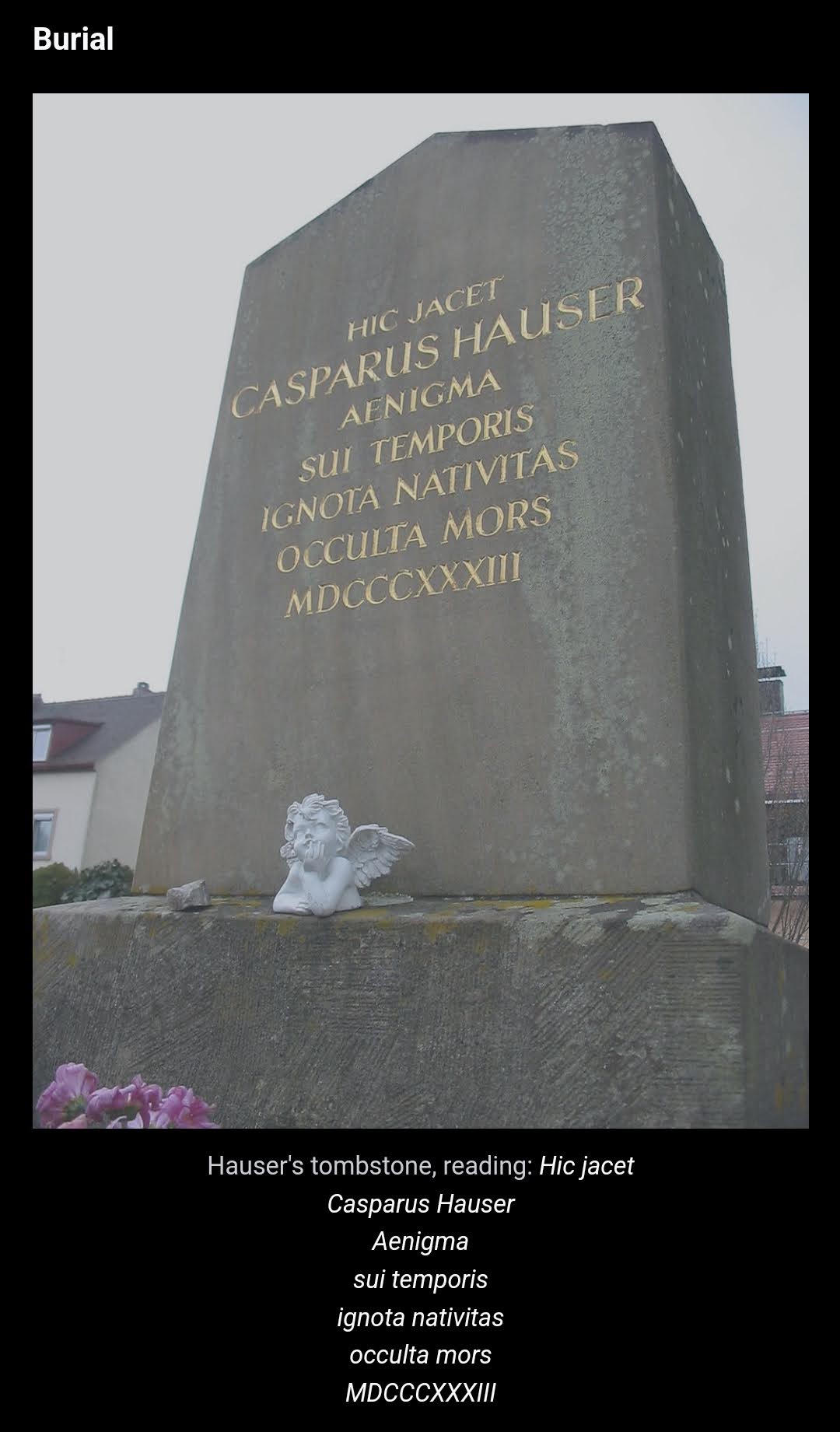
Kaspar Hauser was a real feral child who arrived as a teenager in Nuremburg in 1828. He was taken into various custodies of church and state in 1828.
Over the next few years, Kaspar is prodded, displayed, and ridiculed, then educated and introduced to society. Everywhere he goes he is treated as a curiosity. Kaspar, experiencing the offerings of the world outside of a dark cell for presumably the first time, is unable to indulge basic curiosity about the social order. Kaspar points out contradictions in several instances and is immediately scolded or shunned for questioning norms.
While many have tried to solve the mystery of Kaspar’s origins, Herzog points out this mad tendency within society. He shows that society’s customs and motivations are a pathology. Every instance of trying to understand, solve, or civilize Kaspar, is an opportunity missed to experience him, and to experience the world anew through his eyes. Kaspar connects with nature, and music, and music seems a preferred language.
The film’s German title: Jeder für sich und Gott gegen alle translates to “Every Man For Himself and God Against All.” There is an exchange between Kaspar and his patron:
Patron: “You used to think your dreams were real. It can’t be true when you say you’re only happy in your bed.”
Kaspar: “To me, it seems that my coming into this world was a terribly hard fall.”
In the oppressive structures of social order devised by Europeans, it certainly feels like God is against all.
Kaspar plays with his reflection in a well.From Wikipedia, translates to: “Here lies Kaspar Hauser, riddle of his time. His birth was unknown, his death mysterious. 1833.”
It’s starting to get cold in my part of the world.
Happy People: A Year in the Taiga, co-directed by Werner Herzog and Dmitry Vasyukov in 2010, is free on Tubi, and to prepare myself for winter I watched it. I have no review to share; enough about the film has already been written. There’s a fantastic blog post on a gem of a website: Four Winds 10. The other content on the linked site seems to be more obscure or esoteric content about purification and meditative transcendence, not about films. (I love the worlds you can enter on the internet. Lo and behold, reveries of the connected world!) Instead, I have some musings about cold places to share.
In harsh places, there is a simplicity dictating life and human interaction, because value comes from survival and survival has value. In the Taiga, the hunter/trappers have the land, their dogs, their skills, their moral code, and their traditions and way of life. In the Taiga, the people are deeply and intrinsically tied to the land, and there is an interconnectedness upon which collective survival depends. For settlers in places like California, survival is seen as fleeting, transient, and transactional, and thus is devalued. Individuals are expected to survive, separate from any collective survival. But a hand can’t survive without the rest of the body. Settlers have managed to be creative in the scale and their destruction, in eviscerating parts of the body. In our state capitol just this year, homelessness has increased by 70%.
My life and the lives of non-native folk here on this land, are a product of this destructive settler colonial project. I hope and believe respect can be learned, but it obviously needs to be earned. To work for the land and its people is to work to sabotage the settler colonial project that has passed down generationally and is the structure upon which our society operates. As a settler, one can choose to flee from the struggle, but not as a nomad – as a gentrifier.
The following are a few selections that all involve some adventure in cold and harsh lands – struggles to learn it, survive it, and protect it.
Here’s my entry for the most petit bourgeoisie sentence ever: I came across the spine of this minty blue-green Penguin Classic one day, while perusing a used bookshop in Bushwick. The reverent and enthusiastic introduction by John Glad is what made me buy the book – the first page says something like: “You are about to have your life changed by entering this book…” And so ensue the most incredible, harsh, funny, disgusting, unsentimental, and just real daily lives of Gulag prisoners. I read somewhere that this book is in the East, what “the Gulag Archipelago” is to the West. Worth reading cover to cover!
The University of Illinois book publisher has this amazing free monthly e-book program. October’s free book was an ethnomusicological study of Olonkho, a type of Yakutian (Siberian indigenous) epic poem recited and sung by master poets. There’s a beautiful expression in the book – “to sit under the mouth” – to sit in rapt attention and absorb the tales that range from a few to several dozen thousand lines, from the master Olonkohosut.
A young man from Togo escapes a snake cult, becomes fascinated with Greenland from some random book he found, and makes his way there via Paris and Copenhagen, with no money and no handle of any of the languages. But he learns, and he describes the people, homes, and environs of Greenland through his own lens. It’s a totally unique book of someone plopping from one culture into another, so you get to learn about both Togo and Greenland in the process.
Most of this book is about two people sledding across a giant tundra, and probably the best book for gender expansion and inclusion. It’s the type of book you can read in a day (if you start early).
The chapter entitled “Siberia” that is a mindblowing one in a total mindfuck of a book. One man’s journey inspired by witnessing the death of his parents, took him from scientific exploration to weapon production. This book is not about survival in a place, but rather survival of one’s morals.
Most Herzog fans will have seen his jungle rant already, because it is utterly priceless.
“It’s a land where God, if he exists has created in anger…. there is some harmony here, a harmony of overwhelming and collective murder…”
Whatever happens in the jungle doesn’t stay in the jungle, it stays with you!
Burden of Dreams by Les Blank can be agonizing to watch, because of the immensity of the problems encountered deep in the jungle – one feels the anxiety and tension viscerally, as if we are about to witness a real stabbing or decapitation captured on film.
Fitzcarraldo is then, equally as insane viewing. I watched the following night, and seeing Kinski’s eyes nearly pop out of his skull is magnetic, over-the-top, delightful, at times uproarious.
Iquitos, Peru, thus becomes the character looming over the other larger-than-life characters. The jungle defeats the technology of western civilization. The people who belong to this place, look on in knowing smiles or weary tolerance of the folly of the white man.
I won’t even write too much more about these films, they’ve both been written about more interestingly than I could. I had fun watching them. Watching them both is a good date night idea. It’s interesting, tense, unbelievable. Plus yung Herzog is a fuckin hottie, for real.
Has watching Herzog pull a ship over a mountain inspired you to do anything you thought impossible?
Bonus question: What’s your favorite Herzog quote?
I am not a writer. (if you’ve read any other post on this blog, you may have noticed).
I like to express myself, and I have a lot of interests, but putting it all down and arranging it so it’s coherent and legible is not a personal strength. One of my friends described the way I speak as “jazz.” Another friend described my speaking style “as the rantings of a hobo.” This I know, is offensive, and I think that same friend would have not quite said it that way now. But the spirit is the same – I’m often incoherent
Building a website with a sort of niche famous term, I guess is my way of practicing “in public” which for some reason makes me feel more accountable, and makes myself open to, or subject to, a gaze.
The Herzogian hero is accountable to no one but himself.
I am not interested in being better at writing. I am interested in accomplishing a goal.
. . . . .
Today is October 9, which is eight days away from the one-year anniversary of my mother’s death. This time last year, I would have just arrived in San Diego, knowing I would be staying indefinitely.
When my mom got her terminal prognosis on October 4, 2021, I became zombified. I had just returned from a visit the weekend before, I wasn’t sure how I was going to work out being there for my mom’s hospice, while also keeping my job. But I had to, there was nothing else I could do. I remember that week being a total blur. People at work asking me questions, and whatever answer plucked out of my brain and emerged from my talk hole had literally nothing to do with me. I was on auto-pilot. Until I could get to her, nothing else would matter.
Cancer is bullshit. The cancer treatment industrial complex is fucked. The pathology of needing to “win” or “beat” or overcome makes people do crazy things to poison themselves. I’m not saying cancer treatments don’t work, or that people should not be treated. I am saying there’s a point where chemo does not help someone live a decent fucking life. My mother had terminal cancer from the first day she found out she had cancer cells, which were in her liver and very quickly found they were in her bile duct. Initially, the cancer was classified bile duct cancer. Later, it would be classified as pancreatic cancer. It was never staged exactly – it was always 3 or 4 – but it was subject to some debate between oncologists.
Living in Oakland, California, I couldn’t be near her throughout her entire cancer treatment. While my twin sister went through the daily experience with my mother, taking her to appointments, she said “google is not our friend.” For me, Google became my emotional support, I would furiously be googling the best biliary cancer treatment centers and mRNA treatments and FOLFOX. I had some hope. After the first round of chemo didn’t fucking work at all, the doctors called it pancreatic, which required a whole different kind of chemical cocktail to pump into her tiny little frame. Google told me that Alex Trebek and Patrick Swayze both died after being diagnosed with pancreatic cancer. I knew that if two famous and wealthy white men couldn’t survive this, it was slim to nil that my mother would.
From afar and nearly from the jump, I knew that this cancer was going to be the thing that ended my mother’s life.
The cancer industrial complex, the Livestrong yellow bracelet Susan G. Komen walk, I think there is something very survivor-centric about it all. The stories you hear in people’s bios, is “they won their battle with cancer,” or “they beat cancer.” We hear of alternative treatments, or people’s inspirational bald head stories. Yes, survivors are amazing. It’s incredible. But it’s a game of chance, and a game of economics. If someone is poor already, we know that means disproportionate access and equity in terms of both treatments, and the other things like consistency and a stable environment. But rich people die of cancer too. Good and bad people alive.
Cancer is just one of the cloaks of the grim reaper.
There are parts of “healing” and “moving forward” that make sense to me. I know, and perhaps proudly, that part of me will never heal. I don’t want to heal, one doesn’t heal, I now just live with this abscess, or a chunk of a vital organ removed. In 2021 I was grief personified. Shaved head, scream crying alone in my room, sobbing in public. People call grief before something bad happens “anticipatory” grief and I think there is some truth to that description. But I think it was just regular ol’ grief-grief for me. It’s not that my mom was already dead, but she already lost her ability to do things she wanted. I held out some hope, but by chemo round two I knew we were likely never going to do that road trip to Montana that she one day happily decided she wanted to do with me, I would never take her camping (for her first time), we would never go to the Philippines together (for my first time, my first trip to her motherland). I was grieving the life I wasn’t going to have with my mom.
Of course throughout and intertwined with the grief process, my practice was to just be absolutely present. Not to get all cliche or wooey, but my brain wouldn’t allow me to focus on anything but the here and now. I can’t say my mother got the life she wanted in the last months of her life. But they weren’t altogether bad and we are lucky and blessed for that. She got to be with her grandchildren. I got to spend a good deal of time with her. I can say the times we had together were so many things: ecstatic, sweet, somber, difficult, loving.
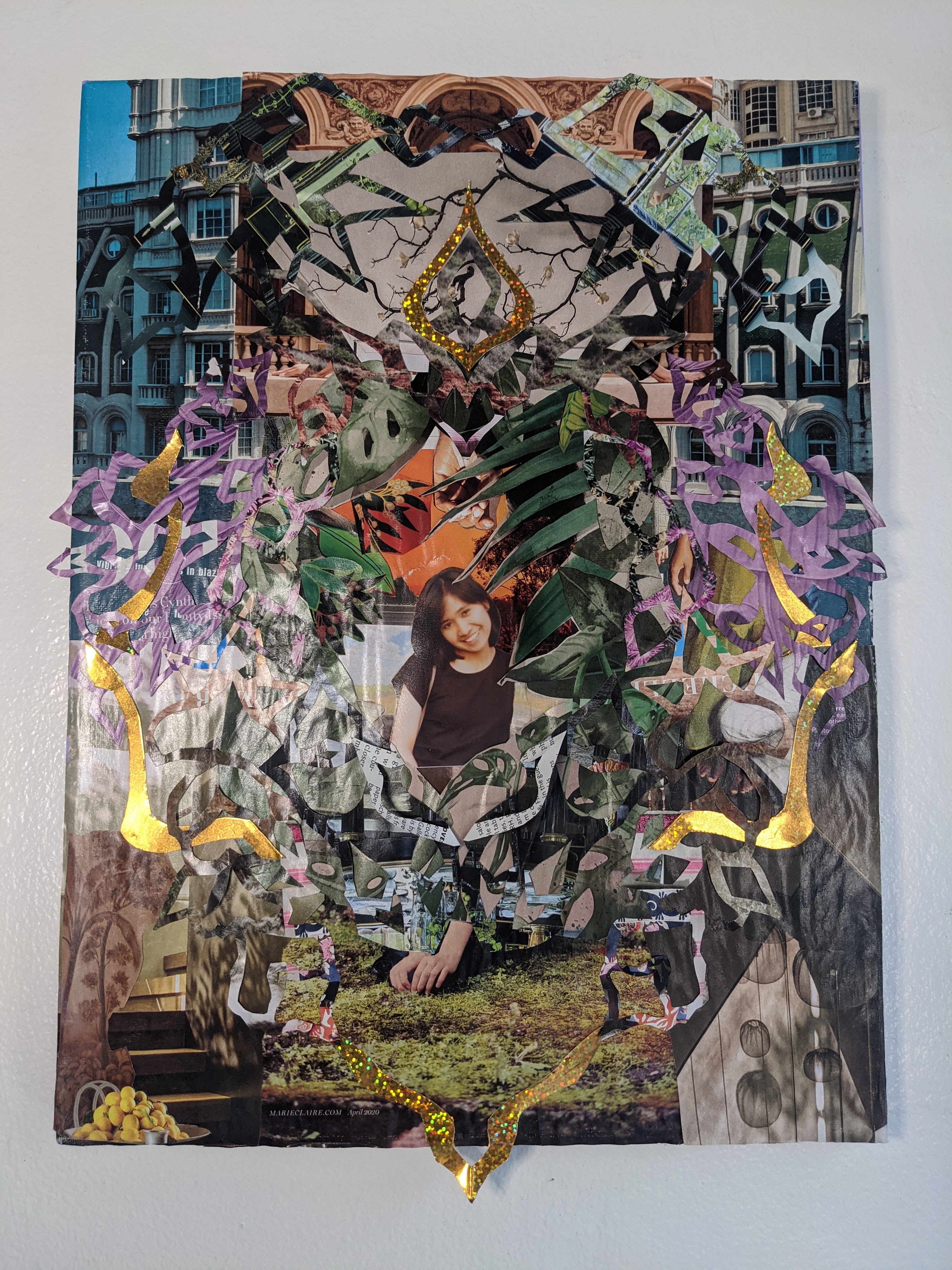
I keep thinking about my mother’s life. I mean to write a eulogy. It’s difficult to write. I honor her in different ways, like with a portrait I did of her while she was on what would be her deathbed. The thing is that is mind blowing and heart-wrenching to me, is my mom was fucking heroic during her death. I wouldn’t describe my mom as having been timid in her life, but she wasn’t exactly adventurous. She just did what needed to be done, especially for me and my sisters, and especially in the most recent decade of her life, for her five(!) grandchildren!
She was heroic in death. Courageous, brave, immensely and unbelievably strong. All these traits which she kept under the surface of her, under a veneer of sweetness, lightness, being happy-go-lucky, rolling with the punches. She was feisty to be sure. Death has grown men, strong men turn into babies. My mother looked death in the face, and she went straight for it. It was the bravest fucking thing I have ever witnessed, and seeing her do that has changed my life forever.
I love her every minute.
Some day maybe I will share “what happened” here on this blog, but maybe it’s not appropriate or necessary. My thing is: being at her side for the last 8 days of her life, it fucking changed me. To see this woman, small, 5’1″, sweet, a bit deferring, just take life by both the horns and the balls and just wrestle it to the ground like defeating a minotaur. Witnessing her has given me an assignment in life. Finishing this Herzog-film-watching project I have given myself, is a weird sidequest in the main quest she gave me. Self-doubt creeps in when I chide myself for being melodramatic – there are countless caregivers who do this for years. I have a quest to do what my mother sent me to do, and it’s out of my lane in life, it feels unconventional and big. But I have to do it, and make it okay, and make it my life. It’s Herzogian. I don’t care if it’s melodramatic. I will either accomplish it or die trying.
Helen Ragus, May 3, 1962 – October 17, 2021. This is a collage portrait we did together while she was on her deathbed. She picked several of the images and I assembled them. I told her she to choose any photo for her own portrait, she chose this sweet pic of her at age 21, from a time when her life was still her own.



 Herzogian