Watching the most recent iterations of political violence unfold in America has prompted me to turn to history. How did people and groups seeking social transformation respond to and survive counterrevolution via targeted mass political violence?
Comparisons have been made of our current moment to several time periods, all with important lessons to draw from. The German Revolution saw an uprising of workers and soldiers who wanted to bring about a Soviet-style government, but the ensuing battles and loss led to the establishment of the far right Weimar Republic, the predecessor to Nazi Germany. The Years of Lead in Italy which were characterized by multiple acts of violence of far-left vs. far right. These warrant further study but now I want to turn into the lessons from Indonesia in the 60s which stands out as a place to study more closely because of the complete and rapid decimation of the Left via two means: effective nationwide anti-Communist messaging, and various gangs that carried out purges with weapons supplied by the Indonesian military and the CIA.
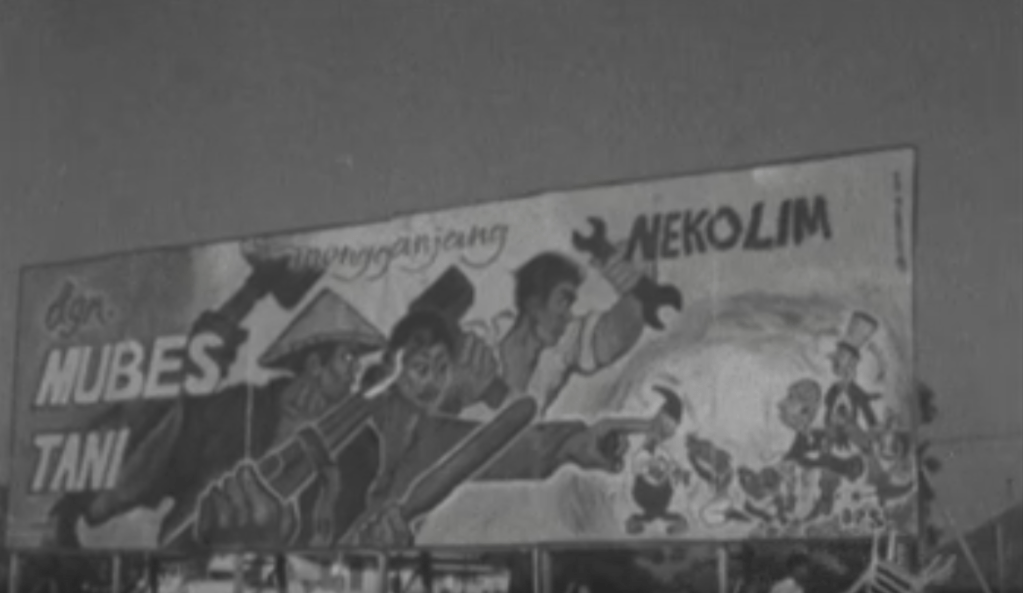
In the 50s and 60s, a long struggle for independence from colonization was finally taking shape as self-determination in various local reforms. After being ruled by the Dutch East India Company, the Dutch, and then the Japanese, programs to reform agriculture and trade to benefit plantation workers, peasants, and poor people were taking place all over the country. In North Sumatra the SARBUPRI, Union of Plantation Workers, were rallying for basic living standards. The Indonesia Peasants Union in Java and Bali sought agrarian reform and landlord resistance. Local struggles under various banners were consolidated under a large alliance called Nasakom, a term coined by the first president of Indonesia, Sukarno, who won the county’s first election in 1960.
Nasakom stood for nationalism, religion, and Marxism, and was at its core, an anti-capitalist and anti-colonialist ideal that sought to model the national government functions after more traditional local village consensus models and self sufficiency, that formed into an ideology developed by Sukarno called Marhaenism. This ideal was aligned with Soviet style functions, thus decades around this period saw the growth of the Partai Komunis Indonesia, or PKI, which in the 50s became the largest non-ruling Communist party in the world. The scale of the changes and new government struggled – it was a difficult time marked by reduced capacity of factories, low export revenue, and high inflation.
This was all during the Cold War, a global rivalry with the United States and Soviet Union. Sukarno was moving trade and investment away from Dutch-aligned countries including the US and Britain, and thus partnering more with China and the USSR. However Sukarno’s vision was ultimately more local and nationalist and was communicated globally. His efforts to ally with other nationalist and post colonial governments led to the Bandung conference, a meeting of 55 mostly African and Asian countries that for the first time pledged economic, political, cultural, and social alignment and support to each other, and was a basis for the Non-Aligned Movement, an eventual formation of 121 mostly developing countries that did not want to align fully with either the US or USSR led blocs.
A rival formation with a different vision for Indonesia was emerging at the time, out of grievances as a result of reforms. The army was losing influence due to more support and emphasis for the PKI and alarmed at Sukarno’s support for the PKI’s wish to quickly establish a “fifth force” of armed peasants and labourers. Muslim clerics, many of whom were landowners, felt threatened by the PKI’s rural land confiscation actions. Adding to this desperate and fractious nature, a split within the military was fostered by Western countries and the CIA backing a right-wing faction, against a left-wing faction backed by the PKI.
On September 30, 1965, a group killed 6 generals in the military and 6 other soldiers. The group said they were pre-empting a coup attempt, and thus took Sukarno under its protection. A general in the army, Suharto, led the effort to quickly blame the PKI. Graphic images and descriptions of the murdered, tortured, and even castrated generals began to circulate the country. Suharto ultimately presented it as a Sukarno-aligned nationwide conspiracy to commit mass murder of Muslims. Millions of people associated with the PKI, even illiterate peasants from remote villages, were presented as murderers and accomplices of the movement. In Walden Bello’s “Counterrevolution, “the PKI was associated with these two words: penghianat (“traitor”) and biadab (“savage”) and action was swift. By October 8, the PKI headquarters in Jakarta were burned down. Thousands of members of PKI student groups were arrested. Suharto secured a presidential decree which gave him authority to take any action necessary to maintain security.
What followed is what Bello called this mass killing “eliminationism,” where the range of the massacred is disputed but is between 500k to 2 million.
“In contrast to Italy, where the security agencies and the bureaucracy let the fascists take the leadership in wiping out the left, the army had an indisputable leadership role in the 1965–66 massacres in Indonesia. Most accounts agree that this was a veritable case of counterrevolution from above carried out principally by the army. Without army leadership, the personal, socioeconomic, religious, and cultural tensions that fueled violent fervor would never have resulted in mass killing and incarceration on such a wide scale.”
“The military signaled ideologically motivated militias to kill local Communist rivals. Given the fact that the military’s capacity was dwarfed by the geographical spread and population of the Indonesian archipelago, the role of these militias in carrying out the army’s master plan was indispensable.”
Communists, red sympathizers and their families are being massacred by the thousands. Backlands army units are reported to have executed thousands of communists after interrogation in remote jails. Armed with wide-bladed knives called parangs, Moslem bands crept at night into the homes of communists, killing entire families and burying their bodies in shallow graves … The murder campaign became so brazen in parts of rural East Java, that Moslem bands placed the heads of victims on poles and paraded them through villages. The killings have been on such a scale that the disposal of the corpses has created a serious sanitation problem in East Java and Northern Sumatra where the humid air bears the reek of decaying flesh. Travelers from those areas tell of small rivers and streams that have been literally clogged with bodies.[60]
—Time, 17 December 1965.
The current state of the Left in the US comes nowhere close to the scale of Indonesia’s Left. Any social gains in the US, if we can call them that, are municipal – tiny and relatively marginal compared to the scale of national crumbling of jobs, housing, health, and education. There is no widespread social reform, there are weak crumbs like the liberal identity based corporate concessions like DEI. Our most recent national election, in the words of Chris Hedges, was a choice between oligarchs and corporatists, and the oligarchs won. The corporatists are falling in line. And the strongest games in town in terms of local social reforms, such as New York City’s Zohran Mamdani and Minneapolis’ Omar Fateh have platforms of bare minimum programs that are indeed desperately needed to relieve widespread poverty, yet these candidates are being erroneously characterized as radical Islamists and Communists.
These days, Stephen Miller aka lil Goebbels, said: MAGA “patriots,” have inherited a civilizing mission from their ancestors. To continue this mission, save humanity, and continue the legacy of [Charlie] Kirk, he said, they must vanquish the “forces of darkness.” They mean every one of their political opponents, from the wide range of black bloc antifa to Elizabeth Warren voters.
The far right-wing and fascist narratives are that anti-Christian and anti-white bias actually exist. So what does this mean for our communities? What will American pogroms look like? Indiscriminate, just like the american attention span? More school shootings? Lone gunmen? The targeting of migrants, Gaza activists, environmental defenders, dissidents of every kind. What about dems in rural areas? The framework for mass repression is already realized in the entire framework of American prisons, jails, homeless shelters – these are the blueprint. The American Counterrevolution has been in place for 100 years. The historic decimation of labor unions, against social reforms and liberation struggles from the red scare to the takedown of the Black Panther Party and militant black power groups, are all part of the sustained war on insurgents and rebels.
In The Act of Killing, which Werner Herzog produced, we follow the director Joshua Oppenheimer as he follows several former commandants of the 1965 death squads. We follow these emotionally damaged buffoons who were, at the time of filming, in positions of power in the army and local towns. They intimidate families and shake down shopkeepers. The documentary is somewhat unique in that it pure observation, in a doc like this you might imagine historical photos, images, or newsreels. Oppenheimer simply drops you in with these “winners” who want to be movie stars, as they do live re-enactments of their mutilations and mass killings. In the process, we witness the totality of their emptiness, the scourge on the human soul that the act of killing creates. I imagine it’s the same emptiness that will haunt the ICE agents of today, who otherwise seem to be ripping families apart with glee. (I encourage readers to watch the film, available free on Tubi).
Resistance to all of this has already been messy and difficult. With maximum charges, terrorism enhancements for antifascist, environmental, and community defense actions. What comes next requires trust, faith, and love.
This love is what drives community based social projects, these are at their essential form survival programs in the face of failing infrastructure, social services and political system. These survival programs are community self-defense against fascistic forces. What makes antifascist community self-defense revolutionary is a commitment to long-term broad social transformation: the revolutionary horizon. My personal belief system, but perhaps not my practical capacities, tell me yes, we must work towards this at all costs. Given the odds, will we ever get there? I’m inspired by the recent film One Battle After Another. While I don’t consider this a revolutionary classic such as “The Battle of Algiers”, the network or highly organized cells is what fighting beyond survival looks like. It’s a thread of love and devotion to each other’s long term survival, each other’s children, that’s going to get us through whatever the next few years of
The battles we have to keep fighting will be less thrilling than the movies. We must do everything we can to protect our neighbors from ICE, getting each other to basic healthcare appointments, and after school tutoring programs so parents can work. This type of everyday antifascism rooted in community self-defense is the only way many will survive the coming authoritarian dictatorship. Otherwise there will be battles – and if the military and militarized forces and militias are firmly on the far-right, we can look to the lessons of Indonesia to teach us what the absolute worst imaginable horror of it looks like.
In future posts, I’ll be sharing my research and lessons of militant resistance from the German Communist Party, the KPD – many of whom hail from Herzog’s home: Bavaria.
Resources:
Free books !!
Walden Bello https://practicalactionpublishing.com/book/415/counterrevolution
Vijay Prashad https://guerrillamamamedicine.tumblr.com/post/28557634602/the-darker-nations-vijay-prashad-full-pdf
 Herzogian